Code of Hammurabi
Also called: Hammurabi’s Code
King Hammurabi of Old Babylonia, who reunited Mesopotamia, had 282 laws carved on a stone stele, including the retaliation principle known as “an eye for an eye”.
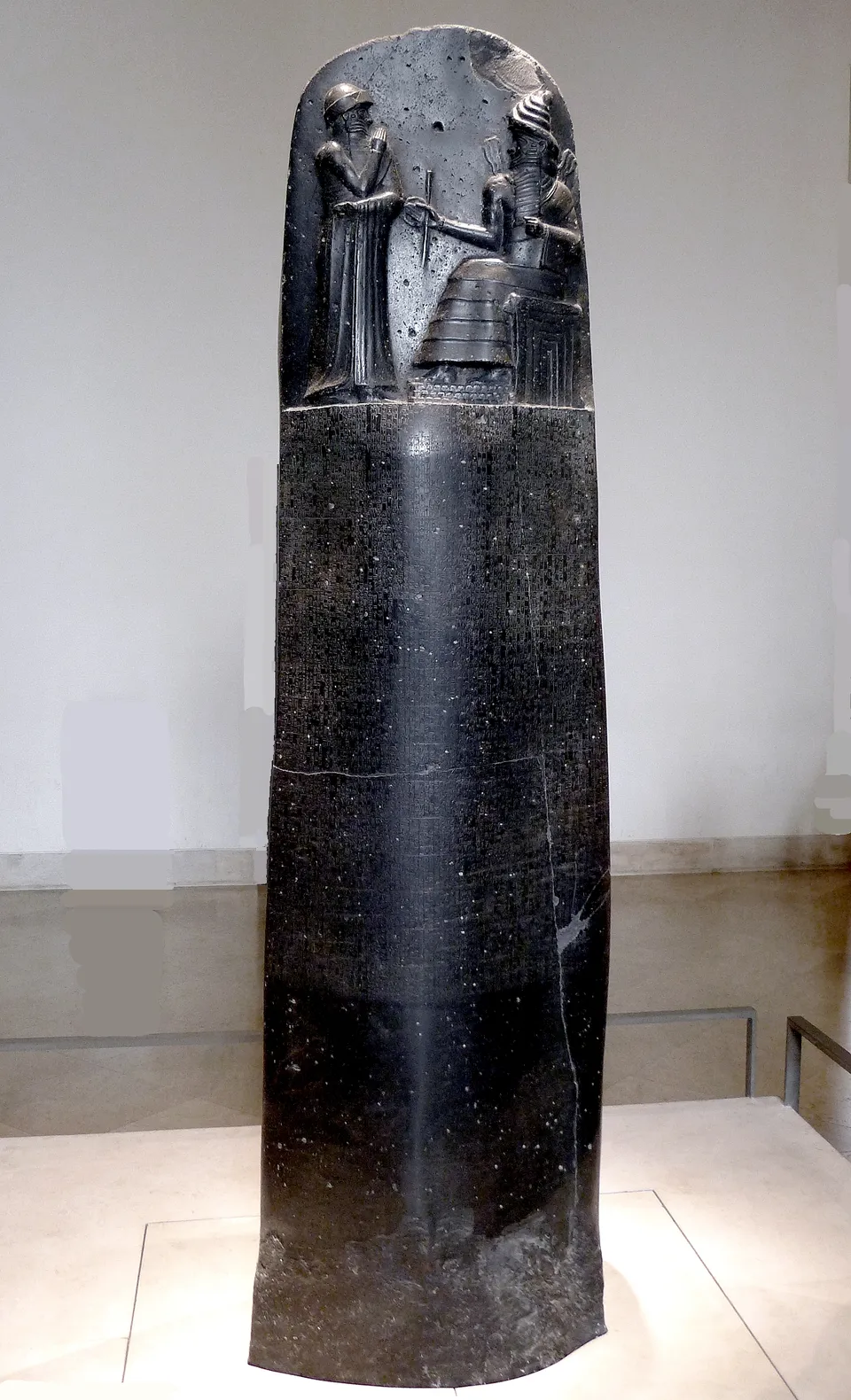
The First Dynasty of Babylon, founded by the Amorites, rose to power under its sixth king, Hammurabi. By about 1755 BC he had conquered his neighbours and reunited Mesopotamia, maintaining the canals and building a centralized state.
Drawing on earlier Sumerian law, he set up a stele inscribed in cuneiform with 282 laws. At the top of the basalt stone, a little over 2 m high, the king stands before Shamash, the sun god of justice. The laws dealt in detail with trade, farming, family, property and slaves, and followed the principle of like-for-like retaliation (lex talionis). Yet punishments varied with the social rank of nobles, commoners and slaves, revealing a rigid class society.
In the 12th century BC the Elamites carried the stele off to Susa as booty; it was excavated there in 1901 and is now in the Louvre in Paris. Old Babylonia fell to a Hittite raid around 1595 BC.