Politics20 July 1907

Forced Abdication of Gojong

Using the Hague mission as a pretext, Japan and pro-Japanese ministers forced Gojong to give up the throne to Sunjong, who took the era name Yunghui.
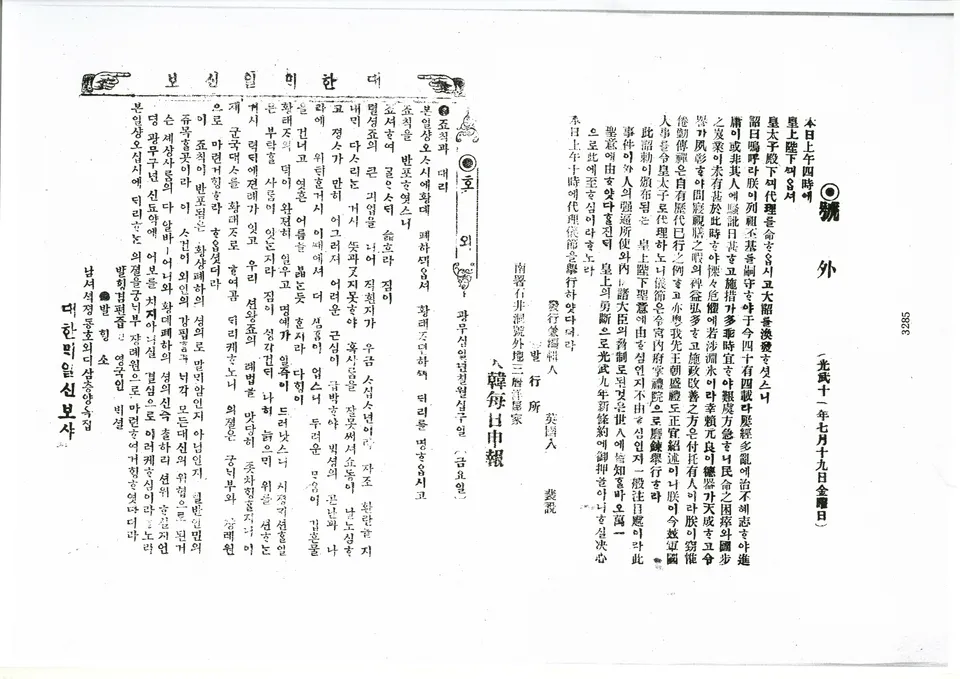
Daehan Maeil Sinbo extra reporting Gojong's forced abdication, 19 July 1907

대한매일신보사 · CC BY-SA 4.0 · Source

Itō Hirobumi and the Lee Wan-yong cabinet blamed Gojong and demanded his abdication. On 19 July Gojong only issued an edict naming the crown prince as regent, but the next day Japan held an abdication ceremony without either of them and treated it as a transfer of the throne. Crowds in Seoul protested and burned Lee Wan-yong’s house.

Four days later Japan forced a new treaty on Korea. Gyeongungung became the retired emperor’s residence under the name Deoksugung, and Sunjong moved to Changdeokgung.

The map in 1907

OpenFreeMap © OpenMapTiles © OpenStreetMap contributors

States and rulers at the time
Korean Empire — Sunjong
Japan · led by — Emperor Meiji
Places
Gyeongungung (Deoksugung)

People

  • Gojong1852 – 1919

    monarch · Twenty-sixth king of Joseon and first emperor of the Korean Empire

  • Sunjong1874 – 1926

    monarch · Second and last emperor of the Korean Empire (era Yunghui), enthroned after Gojong’s forced abdication

  • Itō Hirobumi1841 – 1909

    leader · First prime minister of Japan who forced the 1905 protectorate treaty and became the first Resident-General; shot by Ahn Jung-geun at Harbin

  • Lee Wan-yong1858 – 1926

    leader · One of the Five Eulsa Traitors; as prime minister he signed the 1907 treaty, the 1909 memorandum and the annexation treaty

Before and after