Politics2000

June 15th North–South Joint Declaration

The first inter-Korean summit since division was held in Pyongyang, and a joint declaration was issued.
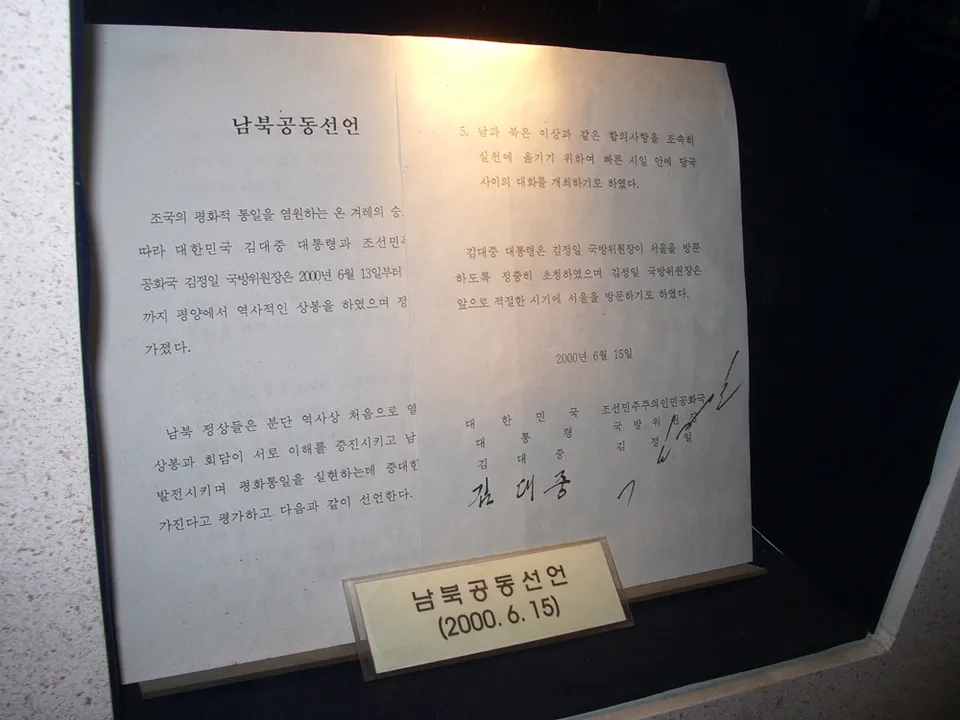
The June 15 Joint Declaration signed by Kim Dae-jung and Kim Jong-il, on display at the Odusan Unification Observatory, Paju

InSapphoWeTrust · CC BY-SA 2.0 · Source

Pursuing reconciliation and cooperation with the North (the Sunshine Policy), the Kim Dae-jung government had arranged Chung Ju-yung’s cattle convoy to the North and Mount Kumgang tours in 1998. From 13 to 15 June 2000 President Kim Dae-jung visited Pyongyang and held a summit with Kim Jong-il, chairman of the National Defence Commission.

The declaration agreed to solve the question of reunification independently, recognized common ground between the South’s confederation proposal and the North’s proposal for a loose form of federation and pledged to pursue reunification in that direction, and promised to resolve the issue of separated families and expand economic cooperation and other exchanges.

Exchanges of separated families, work to reconnect the Gyeongui railway and the building of the Kaesong Industrial Complex followed. Kim Dae-jung received the Nobel Peace Prize that year.

The map in 2000

OpenFreeMap © OpenMapTiles © OpenStreetMap contributors

States and rulers at the time
South Korea — President Kim Dae-jung

People

  • Kim Dae-jung1924 – 2009

    leader · 15th President (1998–2003), the first transfer of power to the opposition by election. Steered recovery from the currency crisis and held the first inter-Korean summit; Nobel Peace Prize 2000

  • Kim Jong Il1941 – 2011

    leader · Son of Kim Il Sung and leader of North Korea (1994–2011). Named successor in 1980; ruled as chairman of the National Defence Commission under "military-first" politics. North Korea gives his birth year as 1942

Before and after

Themes that include this event

  • Changing Unification Policies1948 – 2018

    From “march north” to the Panmunjom Declaration — inter-Korean relations from confrontation to dialogue, through joint statements and agreements to summits (up to 2018)

  • Pyongyang194 BC – 2007

    From Wanggeom-seong of Gojoseon to the inter-Korean summits — capital of Goguryeo, Western Capital of Goryeo, the great city on the Taedong