Perseus and Medusa
Also called: Medusa, Gorgon, Andromeda, Pegasus
A legend handed down over the centuries.
A Greek myth told in Hesiod’s Theogony, Apollodorus’ Bibliotheca and Ovid’s Metamorphoses. With the help of the gods, Perseus, son of Zeus, cut off the head of the Gorgon Medusa, whose gaze turned people to stone, and on his way home rescued Andromeda.
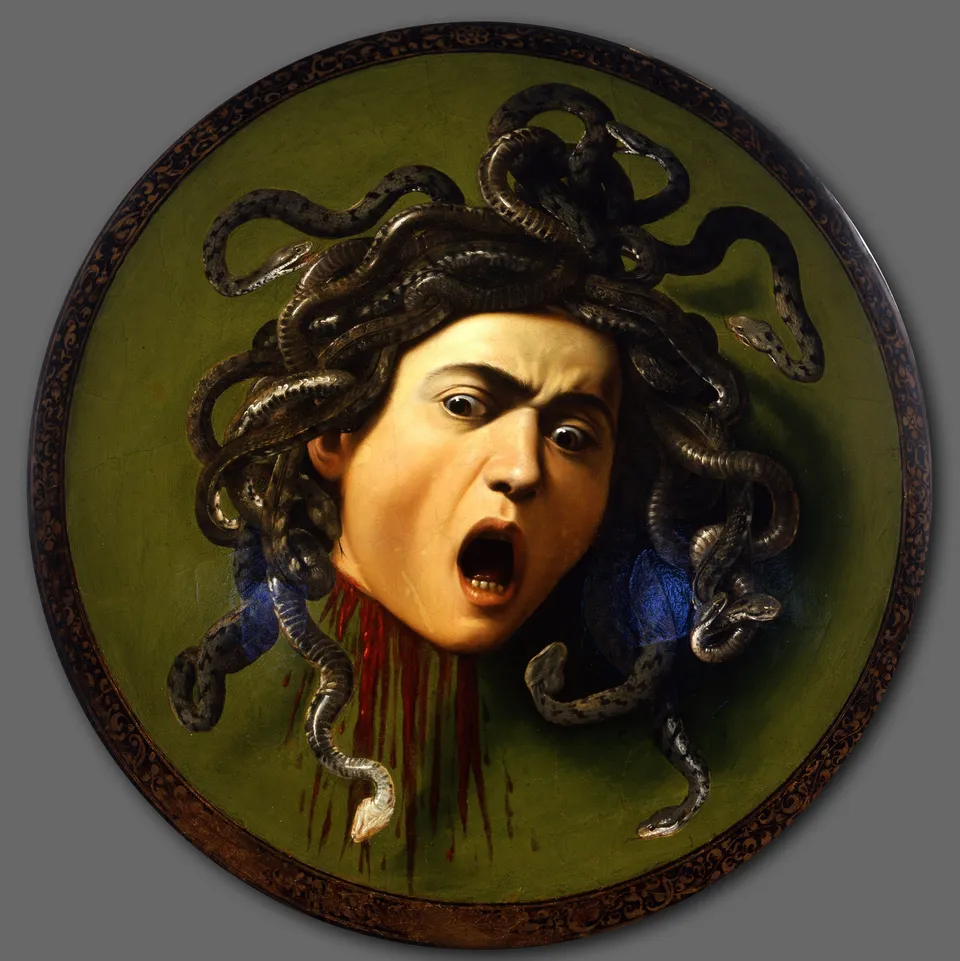
This Greek myth is told in Hesiod’s Theogony, which describes the Gorgons and Medusa, and in Apollodorus’ Bibliotheca (Book 2) and Ovid’s Metamorphoses (Books 4–5), which tell of Perseus’ adventures. Acrisius, king of Argos, warned by an oracle that he would be killed by his daughter’s son, shut his daughter Danaë in a bronze chamber, but Zeus came to her as a shower of gold and Perseus was born. The king set mother and child adrift in a chest, and they came ashore on the island of Seriphos, whose king Polydectes, wanting Danaë, sent Perseus to fetch the head of Medusa.
With the help of Athena and Hermes, Perseus obtained winged sandals, the cap of Hades that made him invisible, a bag for the head and a curved sword. Avoiding Medusa’s gaze, he approached her by her reflection in a bronze shield and cut off her head as she slept; from her severed neck sprang the winged horse Pegasus. On his way home, on the coast of Ethiopia, he rescued the princess Andromeda, chained to a rock as an offering to a sea monster, and married her; on Seriphos he turned Polydectes to stone with the head, which he then gave to Athena to set on her aegis.
Ovid says that Medusa had been a beautiful maiden whose hair Athena turned into snakes in anger over what Poseidon did with her in the goddess’s temple. The oracle was fulfilled when a discus thrown by Perseus at games struck and killed Acrisius. According to Pausanias, Perseus ruled Tiryns instead of Argos and founded Mycenae; Heracles was his great-grandson.