Emperor Yang of Sui Builds the Grand Canal
Also called: Grand Canal
In 605–610 Emperor Yang of Sui completed the Grand Canal linking the Yellow River with the Huai and the Yangtze and north to Zhuo Commandery (today’s Beijing), joining the economy of the south to the political centre in the north.
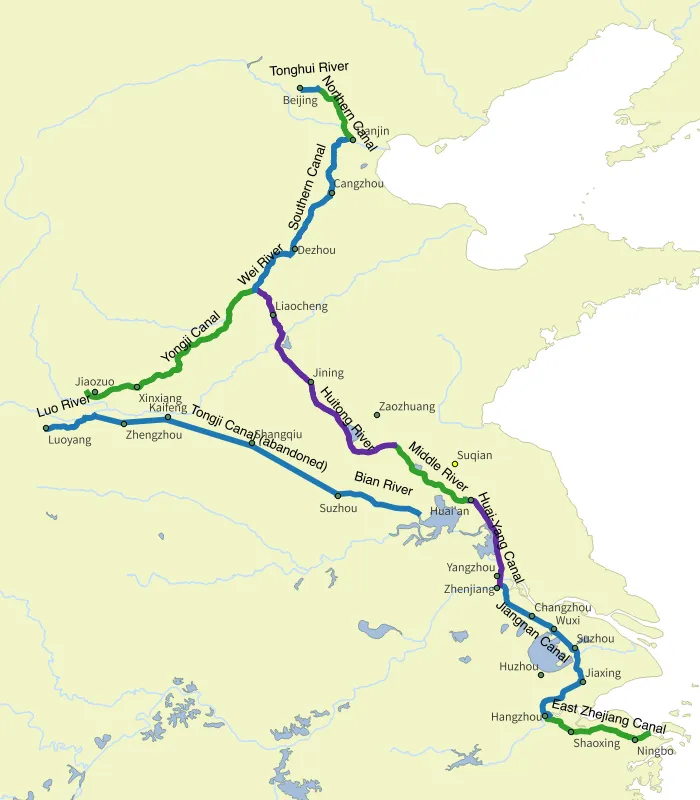
Groverlynn · CC BY-SA 4.0 · Source
After Emperor Wen dug the Guangtong Canal from Chang’an to the Yellow River, Emperor Yang opened the Tongji Canal linking the Yellow River and the Huai in 605, the Yongji Canal from the Yellow River north to Zhuo Commandery in 608, and the Jiangnan Canal south of the Yangtze to Hangzhou in 610. More than 2,000 km of waterways now radiated from Luoyang, carrying rice and goods from the developing south up to the northern capitals.
The Grand Canal remained the artery of the Chinese economy under Tang, Song, Yuan, Ming and Qing. But works that conscripted well over a million people, the building of Luoyang, and three campaigns against Goguryeo (612–614) supplied along the Yongji Canal exhausted the people. After the disaster at Salsu, revolts broke out everywhere, and Emperor Yang was killed by his own officers at Jiangdu (Yangzhou) in 618.