Balfour Declaration
British Foreign Secretary Balfour declared support for establishing "a national home for the Jewish people" in Palestine, adding that the rights of the existing non-Jewish communities would not be prejudiced.
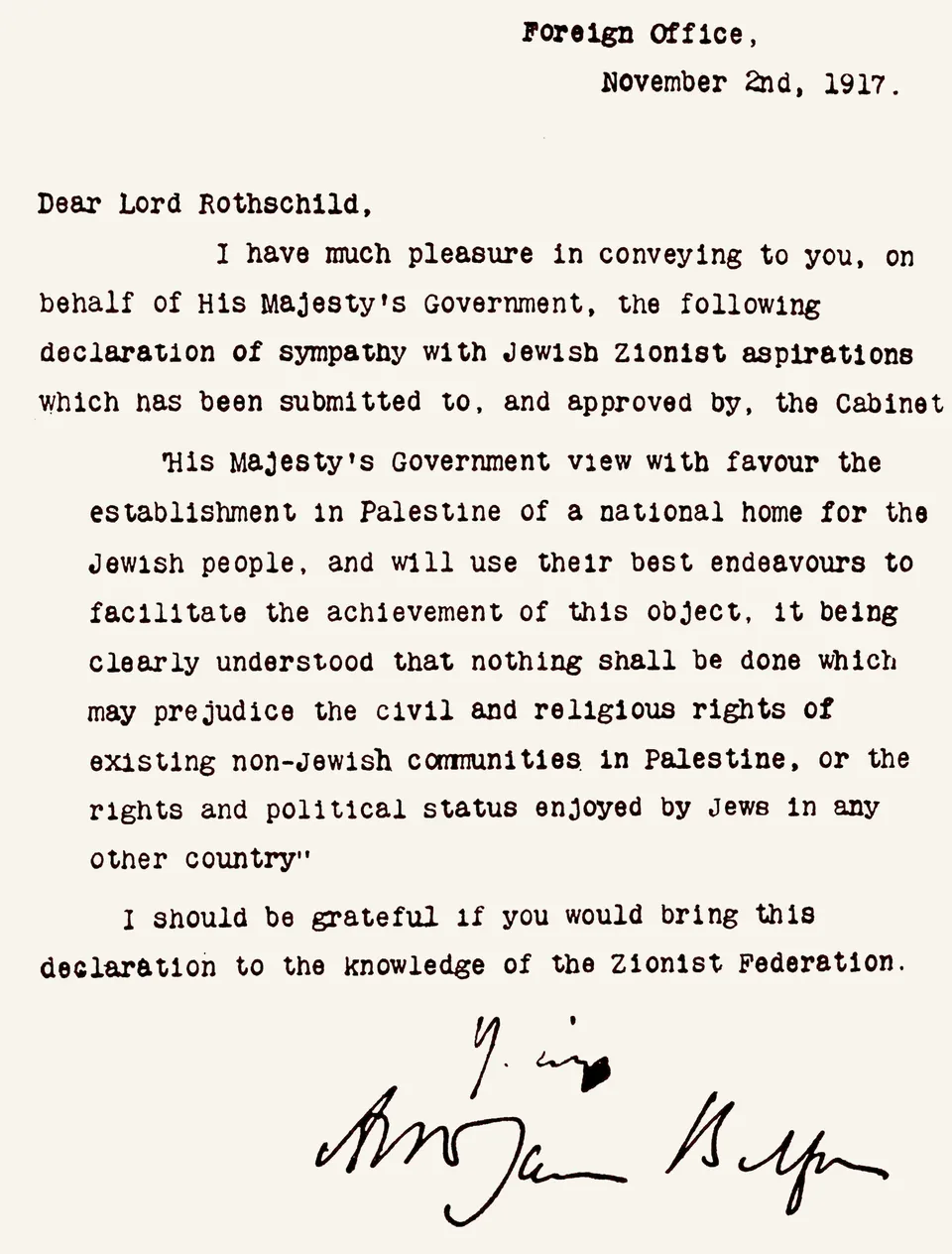
United Kingdom Government signed by Arthur Balfour · Public domain · Source
As persecution of Jews in Europe intensified in the late nineteenth century, the Zionist movement arose, calling for a Jewish state in the ancestral land of Palestine (Zion). During the First World War Britain wanted Jewish support for the war effort and a foothold in Palestine beside the Suez Canal. On 2 November 1917 Foreign Secretary Arthur Balfour wrote to Lord Rothschild, a leader of British Jewry, that the government favoured the establishment in Palestine of a national home for the Jewish people and that nothing would be done to prejudice the civil and religious rights of its non-Jewish communities.
At the time most of Palestine’s population was Arab, and Jews made up less than one in ten. The declaration was written into the British Mandate for Palestine approved by the League of Nations in 1922 and became the basis for Jewish immigration. Israelis see it as international recognition of a Jewish state-building project; Palestinians see it as a promise made without asking the people who lived on the land. Together with the Hussein–McMahon correspondence and the Sykes–Picot Agreement, it is cited as an example of Britain’s contradictory diplomacy.