Politics13 August 1961

Construction of the Berlin Wall

Overnight, East Germany strung barbed wire and then built a wall between East and West Berlin. The Berlin Wall became the symbol of the Cold War and of division.
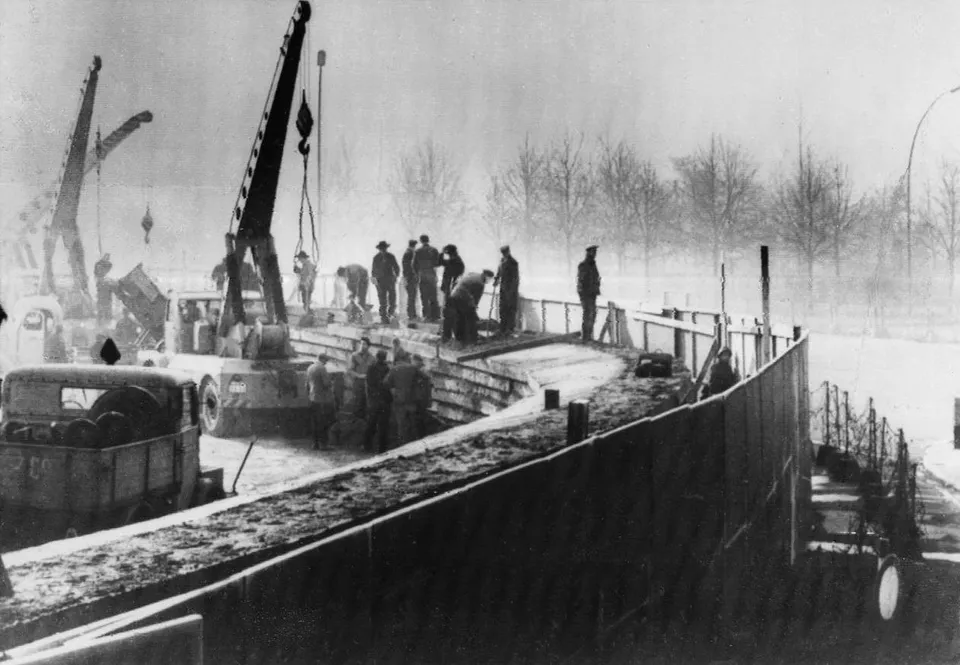
East German construction workers building the Berlin Wall, 20 November 1961

National Archives · Public domain · Source

Between 1949 and 1961 some 2.7 million East Germans left for the West through the still-open city of Berlin. As young skilled workers and professionals drained away, the East German government, with Soviet approval, sealed off West Berlin with barbed wire in the early hours of 13 August 1961 and soon replaced it with a concrete wall.

In October American and Soviet tanks faced each other at Checkpoint Charlie, and in 1963 Kennedy declared in West Berlin, “Ich bin ein Berliner.” More than 140 people died trying to cross the wall, which stood for twenty-eight years until it fell on 9 November 1989.

The map in 1961

OpenFreeMap © OpenMapTiles © OpenStreetMap contributors

States and rulers at the time
East Germany · led by
Soviet Union — Leader Nikita Khrushchev
West Germany
Places
Berlin

People

  • Nikita Khrushchev1894 – 1971

    related figure · First Secretary of the Soviet Communist Party (1953–1964) who denounced Stalin and preached peaceful coexistence, yet confronted the US over the Berlin Wall and Cuba

  • John F. Kennedy1917 – 1963

    related figure · 35th US president (1961–1963) who resolved the Cuban Missile Crisis and launched the Apollo programme; assassinated in Dallas in 1963

Before and after

Earlier
1948 Berlin Blockade

Themes that include this event

  • The Cold War1945 – 1991

    From Yalta to the dissolution of the Soviet Union — half a century in which two blocs led by the US and the USSR divided the world