World history1945 – 199118 events
The Cold War
From Yalta to the dissolution of the Soviet Union — half a century in which two blocs led by the US and the USSR divided the world
U.S. Army photo Photo Credit: USAMHI · Public domain · Source
From Yalta to the dissolution of the Soviet Union — half a century in which two blocs led by the US and the USSR divided the world
U.S. Army photo Photo Credit: USAMHI · Public domain · Source
Roosevelt, Churchill and Stalin met at Yalta in Crimea and agreed on the occupation of Germany, the founding of the UN and Soviet entry into the war against Japan, laying the foundations of the post-war order and the Cold War.
Truman, Stalin and Churchill (later Attlee) settled the treatment of defeated Germany at Potsdam. During the conference the US, Britain and China issued the Potsdam Declaration demanding Japan’s unconditional surrender.
The United States declared a policy of containing communism (the Truman Doctrine) and offered massive aid to rebuild Western Europe (the Marshall Plan). The Cold War began in earnest.
When the Soviet Union cut road, rail and water routes to West Berlin, the US and Britain supplied the city by air for eleven months (the Berlin Airlift). The next year Germany split into East and West.
Victorious in the civil war, the Communist Party proclaimed the People's Republic in Beijing. The Nationalist government withdrew to Taiwan.
The United States, Canada and ten Western European countries signed the North Atlantic Treaty, forming a collective defence alliance; the Soviet Union answered with the Warsaw Pact in 1955.
A war that began with the North Korean invasion of the South at dawn on 25 June 1950. UN and Chinese forces joined, and the armistice of 27 July 1953 drew the present demarcation line.
In divided Vietnam, North Vietnam and the National Liberation Front fought US-backed South Vietnam. After the Americans withdrew, Saigon fell in 1975 and Vietnam was united under communist rule.
The Soviet Union launched Sputnik 1, the world’s first artificial satellite. Shocked, the United States founded NASA, and the space race between the two powers began.
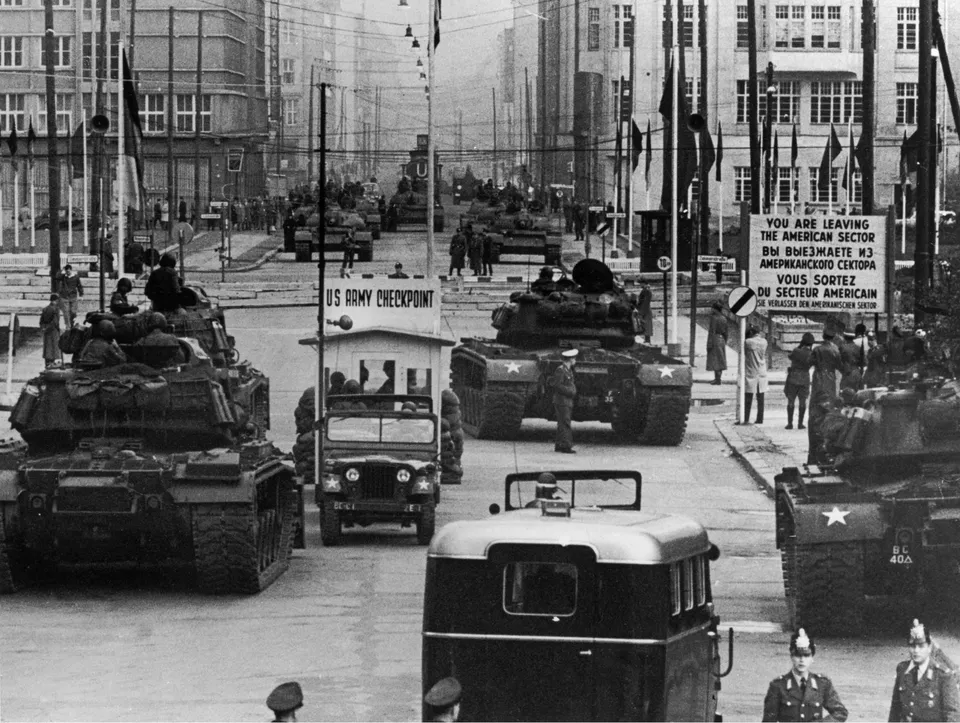
Overnight, East Germany strung barbed wire and then built a wall between East and West Berlin. The Berlin Wall became the symbol of the Cold War and of division.
When the US discovered Soviet nuclear missile sites under construction in Cuba it imposed a naval blockade. For thirteen days the world stood on the brink of nuclear war until the Soviets withdrew the missiles.
Czechoslovakia’s Dubček launched reforms, including press freedom, under the banner of “socialism with a human face”, but Warsaw Pact forces led by the Soviet Union invaded and crushed them.
US President Nixon visited Beijing, met Mao Zedong and issued the Shanghai Communiqué. Sino-American rapprochement ushered the Cold War into an era of détente.
The Soviet Union sent troops to prop up Afghanistan’s communist regime and fought for nearly ten years against mujahideen backed by the US and others before withdrawing in 1989. Détente was over.
Soviet leader Gorbachev introduced restructuring (perestroika) and openness (glasnost) and pursued arms control with the US through his “new thinking”. Communist regimes in Eastern Europe fell one after another and the Cold War ended.
East Germany opened its border and the Berlin Wall came down, a symbol of the end of the Cold War.
East Germany joined the Federal Republic, reuniting Germany after 41 years.
The Soviet Union broke up into fifteen republics, ending the Cold War.
British prime minister (1940–1945, 1951–1955) who led Britain’s resistance through the Battle of Britain and named the “Iron Curtain” in 1946
General Secretary of the Soviet Communist Party who ruled the USSR from the late 1920s until his death, led the war against Germany and drew Eastern Europe into the Soviet bloc
33rd US president (1945–1953) who ordered the atomic bombings, set the policy of containment with the Truman Doctrine and sent US forces to the Korean War
First Secretary of the Soviet Communist Party (1953–1964) who denounced Stalin and preached peaceful coexistence, yet confronted the US over the Berlin Wall and Cuba
37th US president (1969–1974) who issued the Nixon Doctrine, visited China and pursued détente, and withdrew US troops from Vietnam; he resigned over Watergate
35th US president (1961–1963) who resolved the Cuban Missile Crisis and launched the Apollo programme; assassinated in Dallas in 1963
Soviet leader (1964–1982) who crushed the Prague Spring (the Brezhnev Doctrine) and presided over both détente and the invasion of Afghanistan
Soviet leader (1985–1991) and first president of the USSR whose perestroika and glasnost ended the Cold War but could not prevent the Soviet collapse; Nobel Peace Prize 1990
32nd US president (1933–1945) who led the New Deal and took the US to war after Pearl Harbor; he attended the Cairo and Yalta conferences
US Army Chief of Staff in the Second World War and Secretary of State (1947–1949) who proposed the European Recovery Program (Marshall Plan); Nobel Peace Prize 1953
Vietnamese independence leader who proclaimed the Democratic Republic of Vietnam in 1945 and led the wars against France and the United States
Leader of the 1959 Cuban Revolution who made Cuba a socialist state and ruled it until 2008