Conflict17 July 1791

Champ de Mars Massacre

Also called: Fusillade du Champ-de-Mars

The National Guard fired on a crowd gathered to sign a petition for the king’s removal, splitting the revolutionaries into constitutional monarchists and republicans.
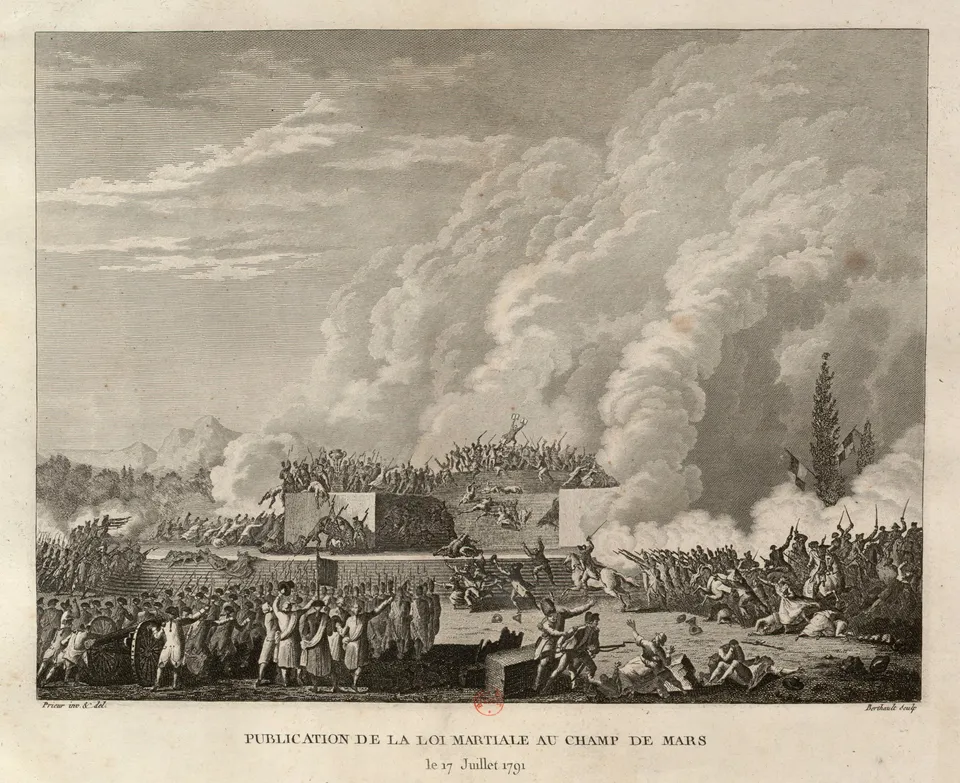
The shooting on the Champ de Mars, 17 July 1791 — etching by Pierre-Gabriel Berthault after Jean-Louis Prieur, from the Tableaux historiques de la Révolution française

Pierre Gabriel Berthault / After Jean-Louis Prieur · Public domain · Source

When the Assembly decided after Varennes not to hold the king responsible, the Cordeliers Club and others drew up a petition demanding his removal. On 17 July 1791 thousands gathered at the “Altar of the Fatherland” on the Champ de Mars to sign it. The mayor of Paris, Bailly, declared martial law, and the National Guard under Lafayette fired on a stone-throwing crowd, killing dozens (about fifty is the figure most often given).

The shooting split those who wished to keep a constitutional monarchy (the Feuillants) from those who wanted a republic. Radicals such as Danton and Marat had to hide or flee for a time, and Lafayette and Bailly lost their popular standing.

The map in 1791

OpenFreeMap © OpenMapTiles © OpenStreetMap contributors

States at the time
France
Places
Champ de Mars, Paris

People

  • Marquis de Lafayette1757 – 1834

    commander · Nobleman and veteran of the American War of Independence who commanded the Paris National Guard and drafted the Declaration of the Rights of Man, and fled abroad in 1792, only to be held captive by the Austrians

  • Georges Danton1759 – 1794

    related figure · Revolutionary orator who led France as Minister of Justice in the crisis of 1792 and was guillotined in 1794 after calling for an end to the Terror

Before and after

Earlier
1791 Flight to Varennes

Themes that include this event

  • The French Revolution1787 – 1799

    From the Assembly of Notables and the Estates-General to the coup of 18 Brumaire — twelve years that toppled the absolute monarchy, founded a republic, passed through Terror and reaction, and ended with Napoleon