Chungju Goguryeo Stele
Also called: Jungwon Goguryeo Stele
A stele Goguryeo raised at Chungju on the Namhan River — the only Goguryeo stele left on the peninsula, showing that Goguryeo reached the upper Namhan valley and held sway over Silla.
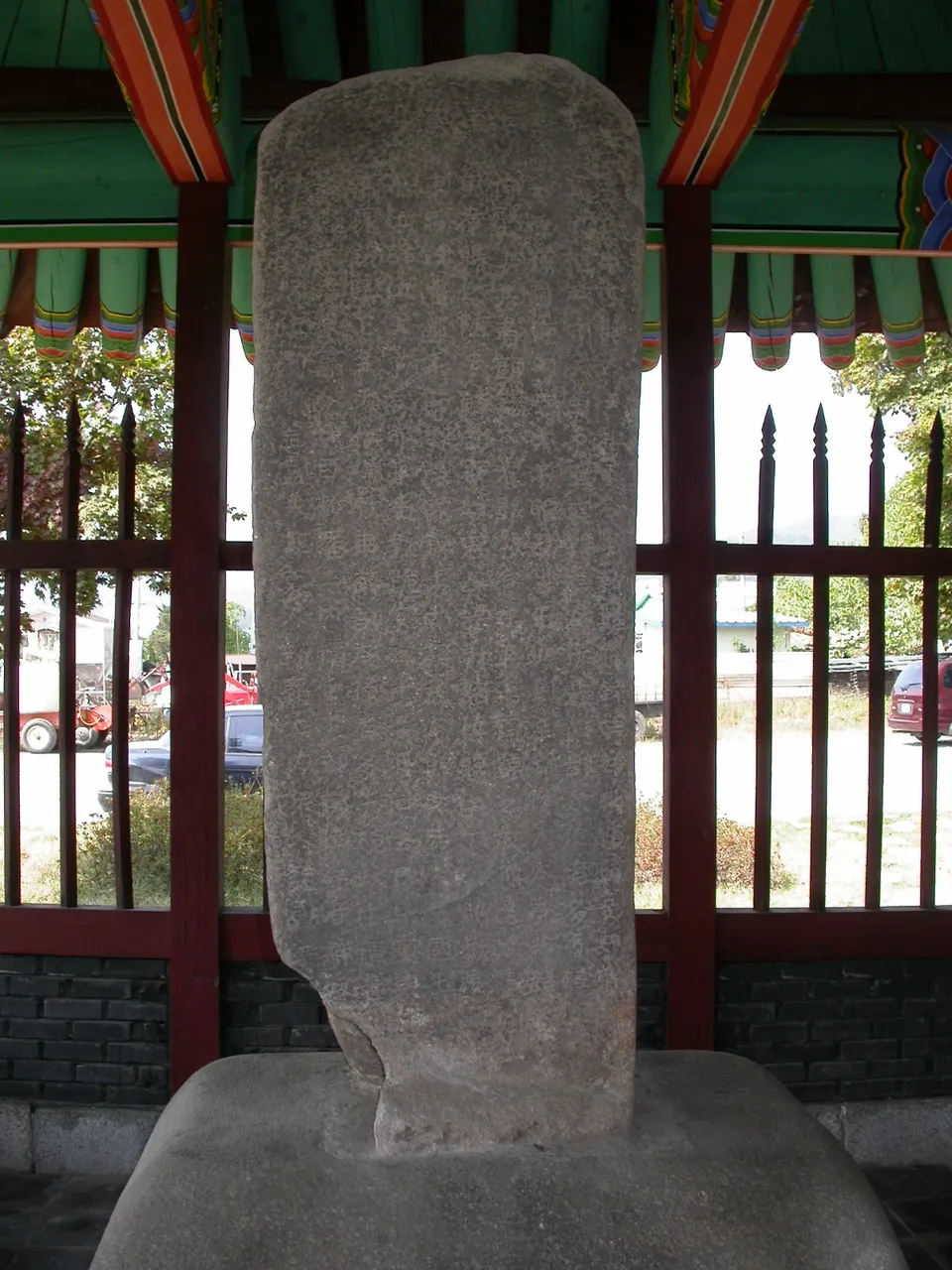
Lawinc82 · CC BY-SA 3.0 · Source
A stone pillar standing in Ipseok village, Gageum-myeon (now Jungangtap-myeon), Chungju, was examined in 1979 and identified as a Goguryeo stele. Characters are carved on all four faces of the square pillar, about 2 m tall, but are badly worn. The text calls the Goguryeo king "Great King of Goryeo" and the Silla king "Dongi maegeum" (maegeum of the "Eastern Yi", a term of Chinese origin for eastern peoples), and records that Goguryeo bestowed robes on the Silla king and his officials. A line mentioning a Goguryeo officer stationed inside Silla territory shows that Goguryeo treated Silla as a junior and exercised influence over it.
Scholars differ on when it was raised — under King Jangsu (mid-5th century) or King Munjamyeong (late 5th century), among other views. After taking Hanseong in 475, Goguryeo held the upper Namhan as far as Chungju, where it set up Gugwon Fortress; Silla later took the area and made it the secondary capital Gugwon (later Jungwon). Long known as the "Jungwon Goguryeo Stele", it is a National Treasure.