The Death of Socrates and Greek Philosophy
In 399 BC an Athenian court sentenced Socrates to death for corrupting the young. His disciple Plato and Plato’s pupil Aristotle built the framework of Western philosophy.
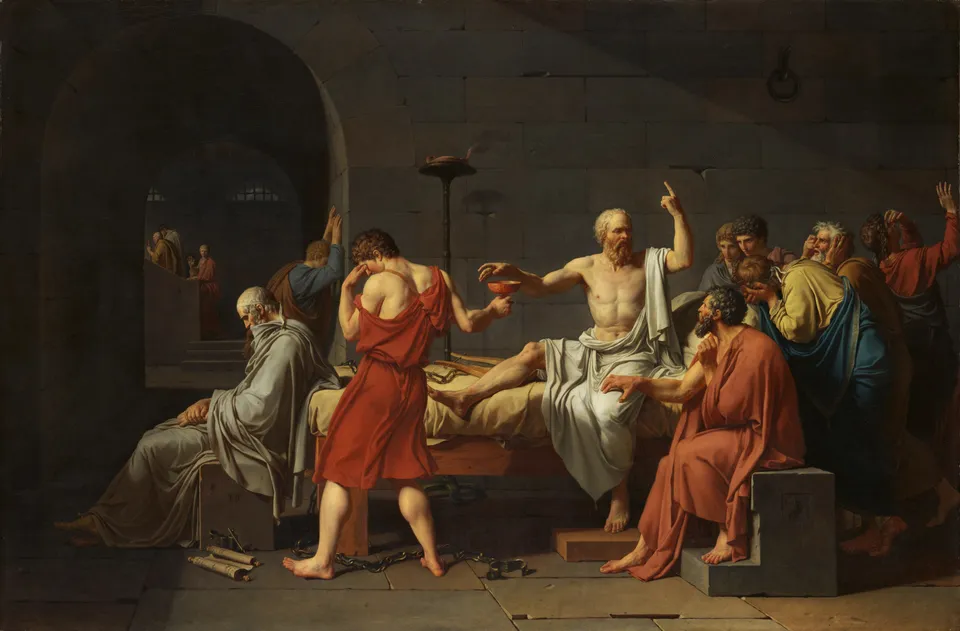
Jacques-Louis David · Public domain · Source
Greek philosophy, which had asked what nature was made of, turned in democratic Athens to man and society. Sophists such as Protagoras, holding that “man is the measure of all things” and that truth differs from person to person, taught the art of persuasion (rhetoric). Socrates opposed them, using dialogue to lead others to recognise their own ignorance and seeking universal truth and virtue.
In the turmoil after Athens lost the Peloponnesian War, Socrates was charged with not believing in the city’s gods and corrupting the young, and in 399 BC he died by drinking hemlock. His disciple Plato founded the Academy, explored the Forms as true reality and argued for rule by philosopher-kings. Plato’s pupil Aristotle, who observed the real world and systematised logic, ethics, politics and natural science, was also Alexander’s tutor.