Evans Excavates Knossos
Also called: Excavation of Knossos, Palace of Minos
In March 1900 the British archaeologist Arthur Evans began excavating Knossos on Crete, uncovering a great palace, the “Throne of Minos” and inscribed tablets. He named the civilisation “Minoan” after the legendary King Minos.
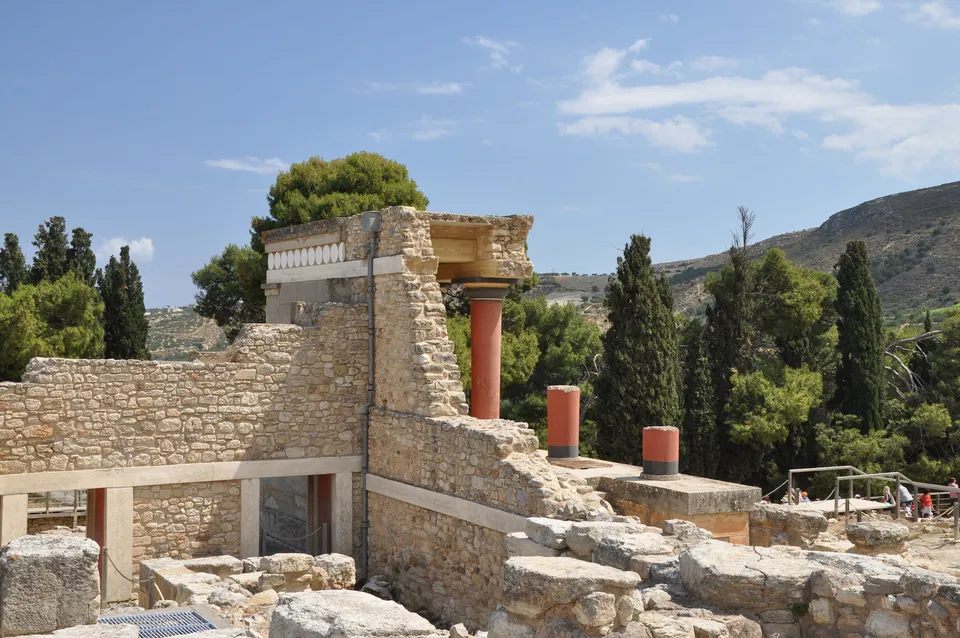
Moonik · CC BY-SA 3.0 · Source
The hill of Knossos was first dug in 1878 by the Cretan merchant Minos Kalokairinos, and Schliemann had tried and failed to buy the land. After Ottoman troops withdrew and the autonomous Cretan State was set up, Evans bought the site through the Cretan Exploration Fund and began digging on 23 March 1900. With the Scottish archaeologist Duncan Mackenzie he uncovered in the first season alone a large part of the palace, the “Throne Room” with its gypsum throne, and a great many clay tablets.
Evans linked the palace to the Labyrinth of King Minos and named the Bronze Age civilisation of Crete, earlier than that of the Greek mainland, “Minoan”. He divided the scripts of the tablets into Linear A and Linear B; in 1952 Michael Ventris read Linear B as Greek, showing that Mycenaean Greeks had been at Knossos. Linear A is still undeciphered. Evans’ work culminated in The Palace of Minos (1921–1935), and he was knighted in 1911.
In the 1920s and 1930s Evans rebuilt parts of the palace in reinforced concrete and heavily restored its frescoes; how accurate these restorations are, and whether the building should be seen as a royal palace at all, are still debated. The finds are in the Heraklion Archaeological Museum, and Knossos became a UNESCO World Heritage Site together with other Minoan palatial centres in 2025.