Politics30 January 1649

Execution of Charles I

Also called: Regicide of Charles I

On 30 January 1649 Charles I, condemned for treason by a special court set up by Parliament, was executed at Whitehall in London.
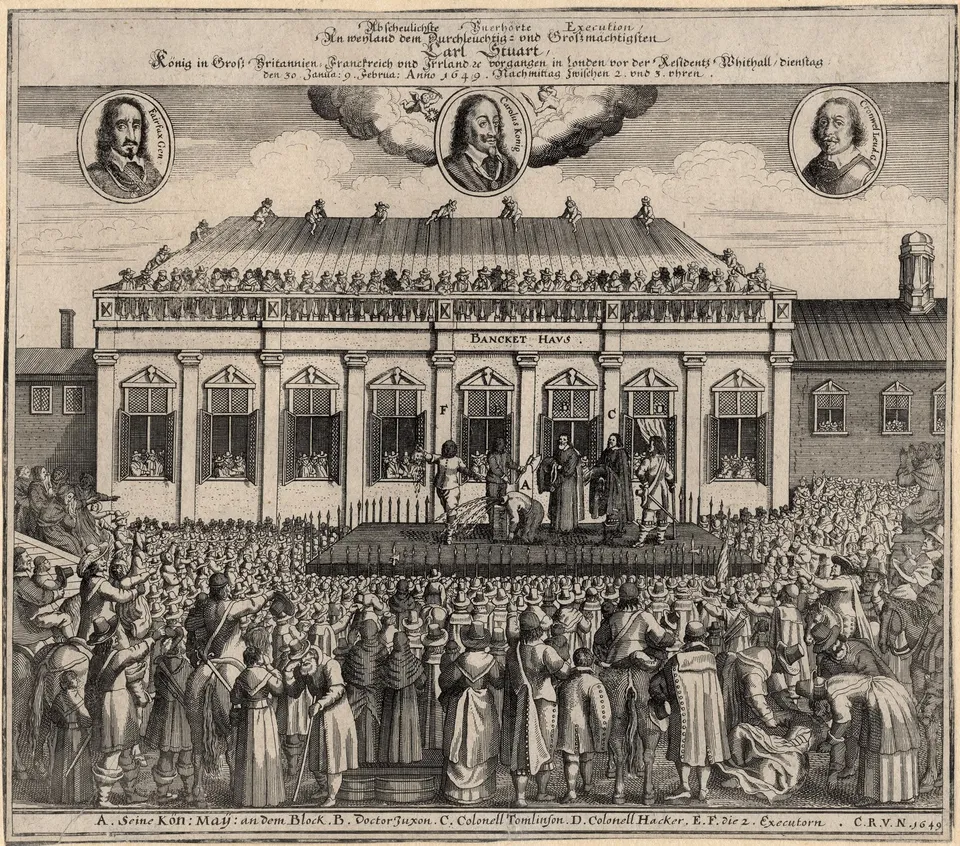
The execution of Charles I before the Banqueting House, Whitehall — painting of about 1649

Unknown author · Public domain · Source

Defeated in the civil war, Charles I allied with the Scots and renewed the fighting. When the Presbyterian members who wanted to keep him as a negotiating partner were expelled by the army in December 1648 (Pride’s Purge), the remaining Rump Parliament set up a High Court of Justice that tried the king as a “tyrant and traitor”. Charles refused to recognise the court but was sentenced to death and beheaded before the Banqueting House on 30 January.

That subjects should try and execute their king shocked the monarchs of Europe. In March Parliament abolished the monarchy and the House of Lords. In the same year in Joseon, King Hyojong came to the throne and began preparing his Northern Expedition.

The map in 1649

OpenFreeMap © OpenMapTiles © OpenStreetMap contributors

States at the time
England
Places
Banqueting House, Whitehall

People

  • Charles I1600 – 1649

    monarch · King of England and Scotland from 1625 to 1649 whose clash with Parliament brought on the Puritan Revolution; he was tried and executed

  • Oliver Cromwell1599 – 1658

    leader · English soldier and statesman who led the Puritan Revolution, defeated the Royalists with Parliament’s army, founded the Commonwealth and became Lord Protector

Themes that include this event

  • Scientific Revolution, Enlightenment and the English Revolutions1543 – 1796

    The Scientific Revolution from Copernicus to Newton, parliamentary government in England won through the Puritan and Glorious Revolutions, and the Enlightenment that sought to remake society by reason — the groundwork of the civic revolutions and the Industrial Revolution