Ten-story Pagoda of Gyeongcheonsa
A Yuan-influenced ten-story marble pagoda was erected at Gyeongcheonsa in Gaepung; it inspired the Wongaksa pagoda of early Joseon.
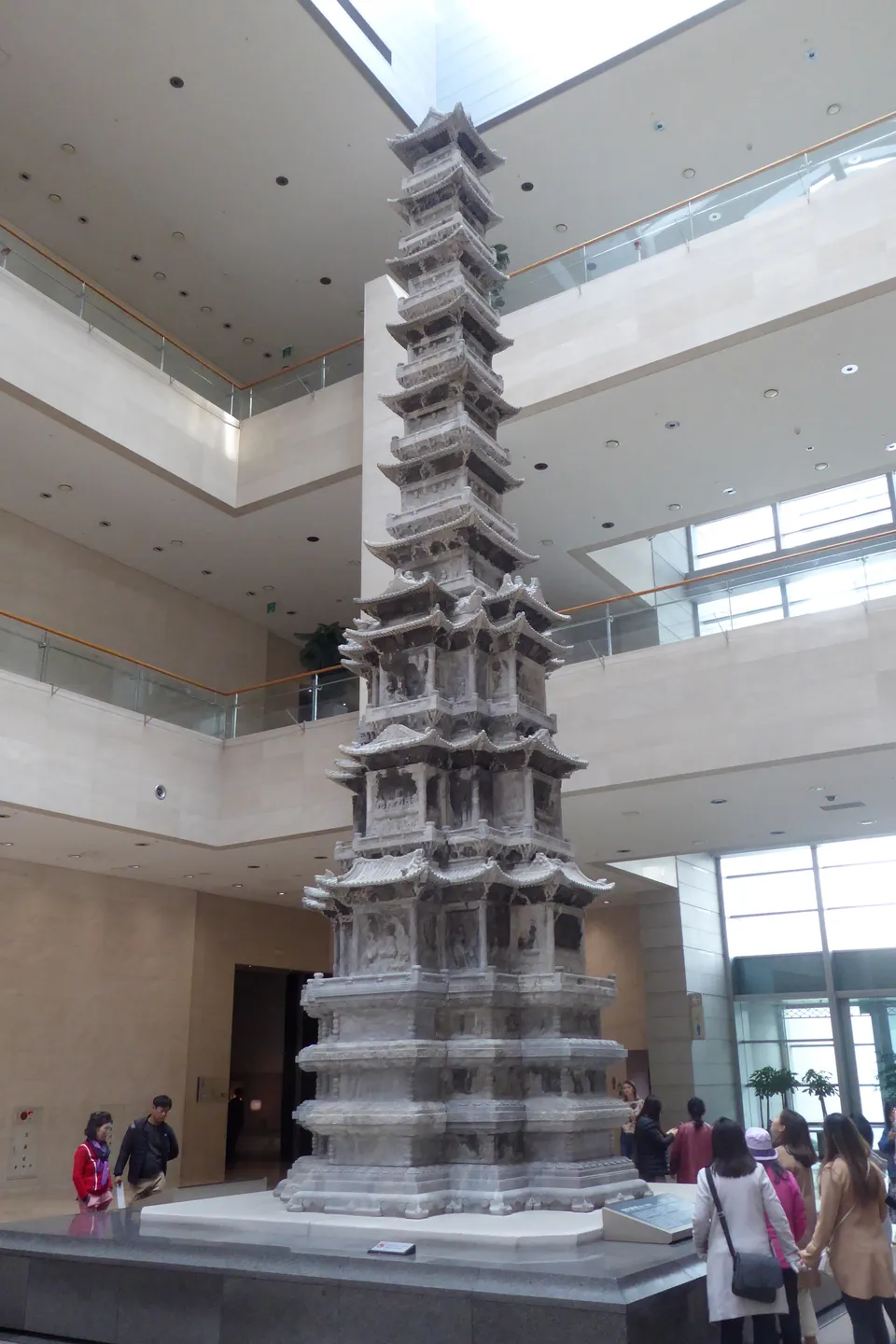
Ethan Doyle White · CC BY-SA 4.0 · Source
Built in 1348, the fourth year of King Chungmok, it bears an inscription praying for the well-being of the Yuan imperial house and the Goryeo royal family. It is made of grey marble, and its base and lower three stories are cross-shaped in plan, like the character 亞. Base and body are densely carved with Buddhas, bodhisattvas and Buddhist scenes, unlike ordinary Goryeo granite pagodas. About 13.5 m tall, it is a designated National Treasure.
In 1907 the Japanese Imperial Household Minister Tanaka Mitsuaki had it dismantled and shipped to Japan; criticism at home and abroad forced its return in 1918. It has stood inside the National Museum of Korea since 2005.