Changes in Pagodas
From Baekje stone pagodas copying timber ones and Silla pagodas copying brick ones, to Unified Silla three-story pagodas and stupas, Goryeo multi-sided pagodas and Yuan-influenced marble towers
Christophe95 · CC BY-SA 4.0 · Source
From Baekje stone pagodas copying timber ones and Silla pagodas copying brick ones, to Unified Silla three-story pagodas and stupas, Goryeo multi-sided pagodas and Yuan-influenced marble towers

Christophe95 · CC BY-SA 4.0 · Source
| Pagoda | Period · state | Type | Features |
|---|---|---|---|
| Bunhwangsa pagoda, Gyeongju | Silla, Seondeok 634 | Brick-imitating stone | Stone cut like bricks; guardian kings, stone lions |
| Mireuksa site pagoda, Iksan | Baekje, Mu 639 | Stone pagoda in timber form | Among the largest and earliest stone pagodas; reliquary record (2009); WHS |
| Hwangnyongsa nine-story pagoda | Silla, Seondeok 645 | Timber pagoda | Urged by Jajang, built by Abiji of Baekje; burned by the Mongols 1238 |
| Jeongnimsa site pagoda, Buyeo | Baekje, 7th c. | Timber-form stone (refined) | Broad thin roof stones; Su Dingfang’s inscription; WHS |
| Gameunsa site pagodas, Gyeongju | Unified Silla, Sinmun 682 | Three stories on a double base (twin) | First of the Unified Silla type; east and west pair |
| Seokgatap and Dabotap, Bulguksa | Unified Silla, Gyeongdeok 751 | Classic three-story / unique form | Dharani sutra found in Seokgatap; WHS |
| Jinjeonsa site pagoda, Yangyang | Unified Silla, 9th c. | Three-story, carved | Eight Guardians and celestials on base, Buddhas on first story |
| Cheolgam stupa, Ssangbongsa | Late Silla, c. 868 | Octagonal stupa | Relic stupa of a Seon master; magnate patronage; the finest stupa |
| Woljeongsa octagonal pagoda | Early Goryeo | Multi-sided, many-storied | Song influence, common in the old Goguryeo north; offering bodhisattva |
| Gyeongcheonsa site pagoda | Goryeo, Chungmok 1348 | Marble, many-storied | Yuan influence, 亞-shaped base; taken to Japan, returned |
| Wongaksa site pagoda, Seoul | Joseon, Sejo 1467 | Marble, many-storied | Modelled on Gyeongcheonsa pagoda; Tapgol Park |
Built with Bunhwangsa in 634 under Queen Seondeok. Its stones are cut and stacked like bricks, and it is the oldest surviving Silla stone pagoda.
King Mu of Baekje built Mireuksa, the largest Baekje temple; its west pagoda, modelled on wooden pagodas, is among the oldest stone pagodas in Korea.
On the monk Jajang’s advice, Queen Seondeok built a nine-storey wooden pagoda some 80 m tall at Hwangnyongsa, raised by the Baekje master builder Abiji.
A Baekje stone pagoda on the site of Jeongnimsa in the heart of the Sabi capital — the refined culmination of Baekje’s stone pagodas modelled on timber ones.
King Sinmun completed Gameunsa, begun by his father Munmu; the legend of the Manpasikjeok, a flute received from the dragon of the East Sea, dates from this time.
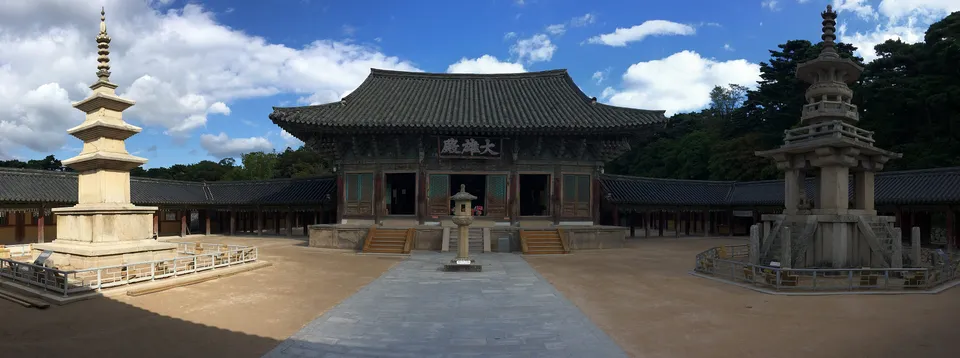
Kim Dae-seong, chief minister under King Gyeongdeok, began Bulguksa and the Seokguram grotto on Mount Toham — the summit of unified Silla’s Buddhist art.
A late Unified Silla pagoda at the temple where Doui, who brought Seon from Tang, lived. The Eight Guardians on its base and Buddhas on its first story show the period’s taste for carved decoration.
An octagonal stupa holding the relics of the Seon master Cheolgam (Doyun). Carved down to the tiles of its roof stone, it is counted the finest of the Silla stupas.
An early Goryeo pagoda at Woljeongsa on Mount Odae. An octagonal nine-story pagoda, it represents the multi-sided, many-storied Goryeo pagodas that, under Song influence, flourished in the north, the old Goguryeo lands.
A Yuan-influenced ten-story marble pagoda was erected at Gyeongcheonsa in Gaepung; it inspired the Wongaksa pagoda of early Joseon.
The marble pagoda (1467) of Wongaksa, which King Sejo built in the heart of Hanyang. Modelled on Goryeo’s Gyeongcheonsa pagoda, it is a rare Buddhist monument from Confucian Joseon.
Twenty-seventh ruler and Silla's first queen, under whom Cheomseongdae and the nine-storey pagoda of Hwangnyongsa were built
Silla monk who, back from Tang, urged Queen Seondeok to build the nine-storey pagoda of Hwangnyongsa
Munmu's son and 31st king of Silla, who crushed Kim Heum-dol's revolt and strengthened royal power through the National Academy, the nine provinces and office-land grants
Thirtieth king of Silla, who destroyed Goguryeo, expelled Tang and completed unification
Chief minister under King Gyeongdeok who, according to the Samguk yusa, began Bulguksa and Seokguram
35th king of Silla, who sinicized official titles and place names but restored the nogeup stipend villages; Bulguksa and Seokguram were begun in his reign
Monk who brought Seon (Chan) Buddhism from Tang in 821 and is honoured as founder of the Gajisan school

Seized power in the 1453 coup and took the throne from his nephew Danjong