Travels of Ibn Battuta
Also called: Rihla, The Travels of Ibn Battuta
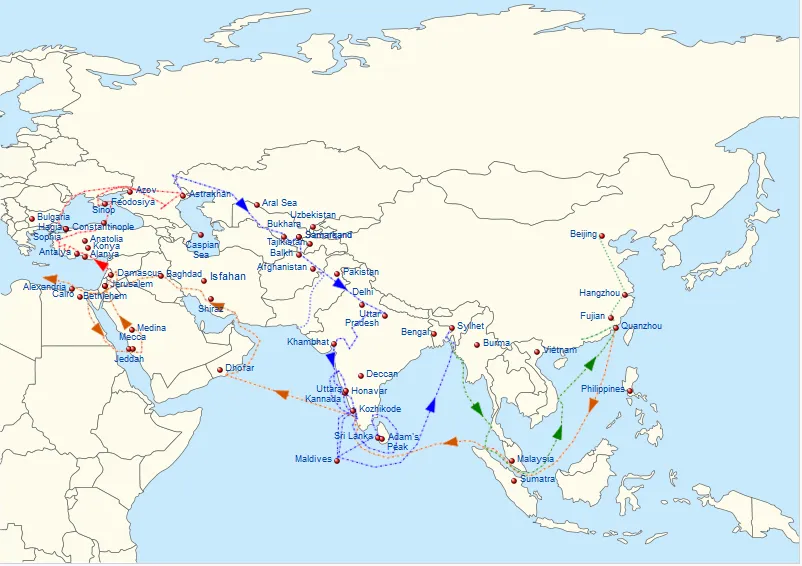
Ibn Battuta of Tangier in Morocco set out on the pilgrimage to Mecca and spent some thirty years travelling the Islamic world, India, China and Africa, leaving his famous Travels.
Wikipedia users · CC BY-SA 3.0 · Source
Ibn Battuta left his home town of Tangier in 1325, aged twenty-one, to make the pilgrimage to Mecca. He went on through Egypt, Syria, Iraq and Iran, toured Arabia and the East African coast (Mogadishu, Kilwa), crossed Anatolia and the steppes of the Golden Horde and passed through Central Asia to India. He served for years as a judge under Muhammad bin Tughluq of the Delhi Sultanate, and by way of the Maldives and Ceylon reached Quanzhou in late-Yuan China. After returning to Morocco in 1349 he still travelled to Granada in Iberia and across the Sahara to the Mali Empire.
The scholar Ibn Juzayy wrote down what he dictated as the Rihla (Travels). Most of the places he visited were ruled by Muslims or home to Muslim merchants, so he could work and be received through a shared Arabic language and Islamic law. The account shows the 14th-century world in which the Mongol empire had linked land and sea routes, and is ranked with Marco Polo’s earlier Travels. Muslims from the west (Hoehoe people) also lived in Goryeo, then under Yuan domination, and the Goryeo song “Ssanghwajeom” features a “Hoehoe man” running a dumpling shop.