The Lytton Report and Japan’s Withdrawal from the League of Nations
Also called: Lytton Commission, Lytton Report
When the League of Nations, drawing on the Lytton Commission’s report, refused to recognize Manchukuo and called for the withdrawal of Japanese troops, Japan gave notice in March 1933 that it would leave the League.
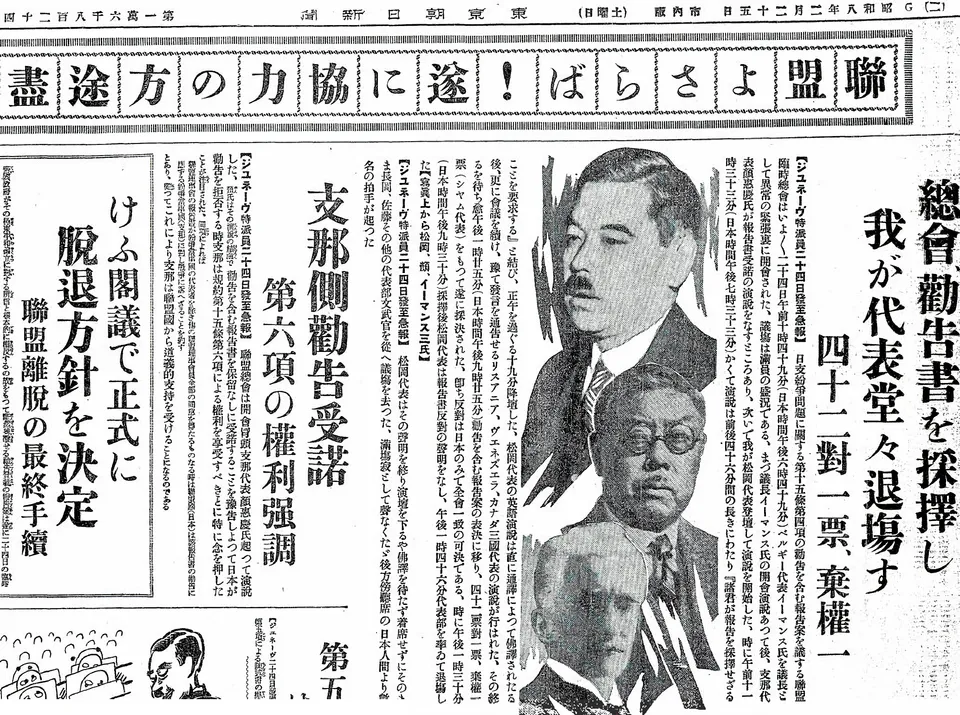
Tokyo Asahi Shimbun · Public domain · Source
In response to China’s appeal, the League sent a commission headed by Britain’s Lord Lytton to Manchuria, Japan and China. Its report, published in October 1932, accepted some of Japan’s interests in Manchuria but concluded that the Kwantung Army’s actions could not be regarded as self-defence and that Manchukuo was not the product of a genuine and spontaneous independence movement.
On 24 February 1933 the League Assembly in Geneva adopted recommendations based on the report by 42 votes to 1 (Japan against, Siam abstaining), and the Japanese delegate Matsuoka Yōsuke walked out. Japan gave notice of withdrawal on 27 March and went on to abandon the Washington and London naval treaties, isolating itself internationally. Exposed as powerless to stop aggression, the League proved equally helpless when Germany withdrew and Italy invaded Ethiopia.