ConflictMay – December 1874

Japanese Expedition to Taiwan

Also called: Taiwan Expedition of 1874, Mudan Incident

Citing the murder of Ryukyuan castaways by Indigenous Taiwanese, Japan sent troops to southern Taiwan — the Meiji government’s first overseas military expedition.
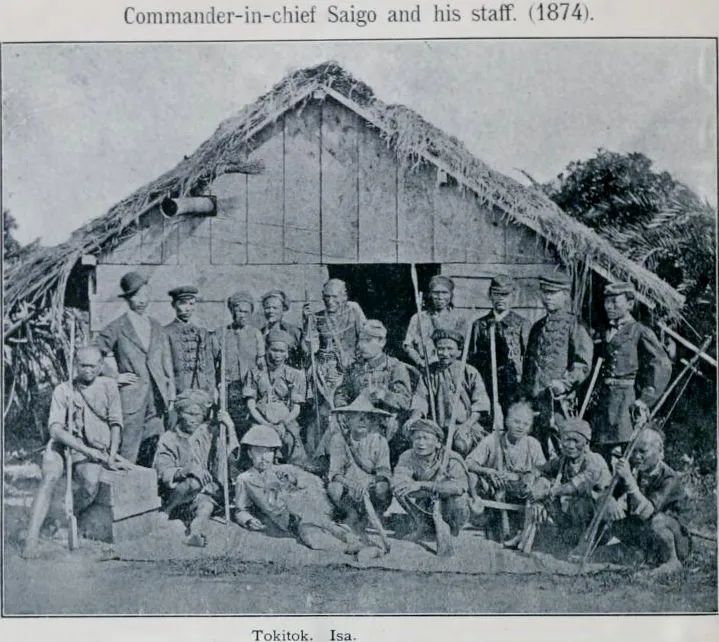
Saigō Tsugumichi (centre), commander of the Taiwan expedition, with Taiwanese Indigenous leaders, 1874

J.W. Davidson · Public domain · Source

In 1871 some fifty shipwrecked Ryukyuans from Miyako were killed by Indigenous people in southern Taiwan. Claiming the Ryukyuans as its own subjects, and seizing on a Qing reply that the Indigenous lands lay beyond its rule, Japan landed more than 3,000 troops under Saigō Tsugumichi in May 1874. Far more soldiers died of disease than in battle. In October, with British mediation, the Qing paid 500,000 taels and acknowledged the expedition as a "just act to protect subjects"; Japan withdrew, and the agreement became a basis for its claim that the Ryukyus belonged to Japan.

The map in 1874

OpenFreeMap © OpenMapTiles © OpenStreetMap contributors

States and rulers at the time
Japan · invader — Emperor Meiji
Qing — Tongzhi Emperor
Ryukyu

People

  • Ōkubo Toshimichi1830 – 1878

    diplomat · Satsuma statesman who led the early Meiji government, pushing through the abolition of the domains and state-led industry, and opposed invading Korea

Before and after

Themes that include this event

  • The Opening of East Asia1839 – 1901

    From the Opium War to the Boxer Protocol — sixty years in which China, Japan and Korea, forced open by Western gunboats, each tried to reform and went separate ways