PoliticsApril 223

Liu Bei’s Charge at Baidicheng

Also called: Liu Bei’s deathbed charge

Defeated at Yiling, Liu Bei fell ill at Baidicheng and, dying in 223, entrusted his son Liu Shan and the kingdom to his chancellor Zhuge Liang: "If my son can be helped, help him; if not, take the throne yourself."
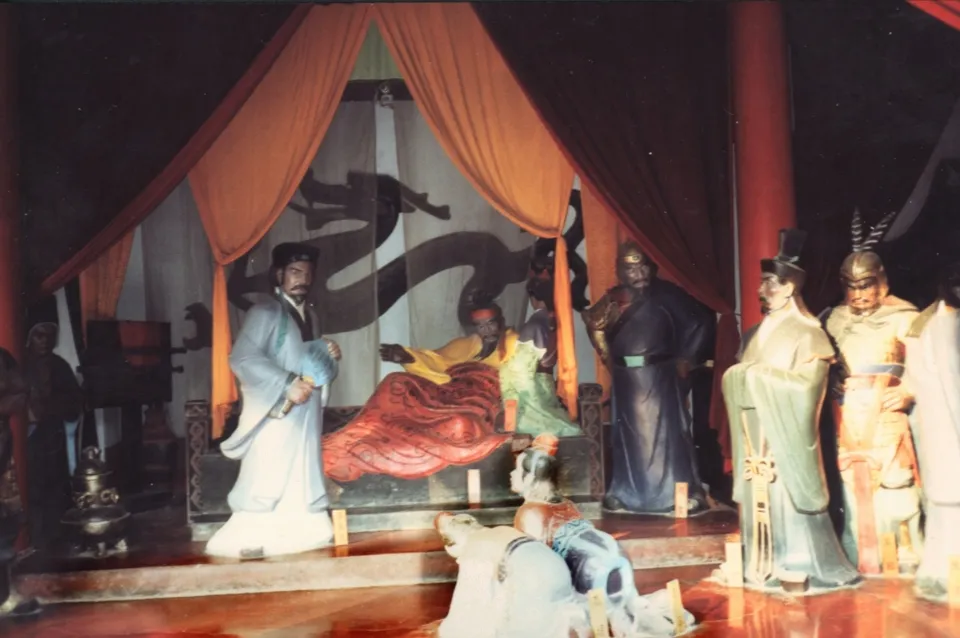
The Tuogu Hall at Baidicheng, depicting Liu Bei entrusting his son and kingdom to Zhuge Liang — Fengjie, Chongqing

Gisling · CC BY-SA 3.0 · Source

After his crushing defeat at Yiling in 222, Liu Bei did not return to Chengdu but stayed at Baidicheng (Yong’an), where he fell ill. In April 223 he summoned Zhuge Liang: "Your talent is ten times Cao Pi’s; you will surely bring peace and achieve great things. If my son can be helped, help him; if he is unworthy, take the throne yourself." Weeping, Zhuge Liang vowed loyalty to the end.

To his son Liu Shan, Liu Bei left the words: "Do not do evil because it is small; do not leave good undone because it is small." The seventeen-year-old Liu Shan became emperor, and Zhuge Liang as chancellor took charge of all the affairs of Shu Han.

The map in AD 223

OpenFreeMap © OpenMapTiles © OpenStreetMap contributors

States at the time
Shu Han
Places
Baidicheng

People

  • Liu BeiAD 161 – AD 223

    key figure · Founding emperor of Shu Han (Emperor Zhaolie), who claimed descent from the Han house and became emperor at Chengdu in 221

  • Zhuge LiangAD 181 – AD 234

    key figure · Chancellor of Shu Han, who proposed the plan to divide the realm in three to Liu Bei in 207 and died of illness on the Wuzhang Plains in 234 during his northern campaigns

  • Liu ShanAD 207 – AD 271

    related figure · Second and last emperor of Shu Han, who surrendered when Wei’s Deng Ai reached Chengdu in 263

Before and after

Earlier
AD 222 Battle of Yiling

Themes that include this event

  • The Three KingdomsAD 184 – AD 280

    From the Yellow Turban Rebellion to the Jin reunification — a century of Wei, Shu and Wu, the age of Cao Cao, Liu Bei and Sun Quan