Qianlong’s Conquests and the Siku Quanshu
Also called: Siku quanshu, Complete Library of the Four Treasuries, Ten Great Campaigns
The Qianlong Emperor destroyed the Dzungars and conquered the Tarim Basin, giving the Qing its greatest extent, and gathered the empire’s books into the Complete Library of the Four Treasuries.
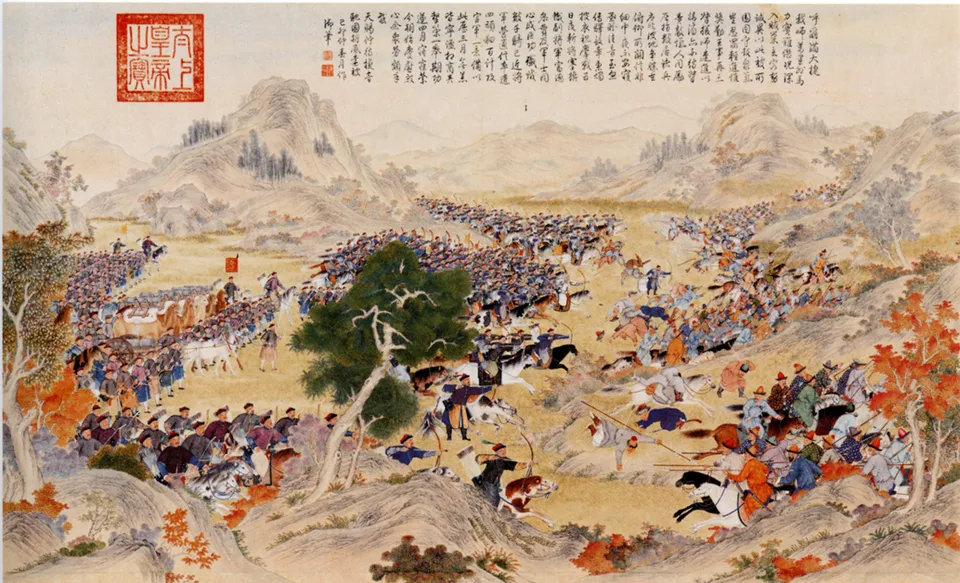
A collaboration between Chinese and European painters. The Jesuit missionaries involved in producing the drawings in China were Giuseppe Castiglione, Jean-Denis Attiret, Ignace Sichelbart and Jean Damascene. The engravings were executed in Paris under the direction of Charles-Nicolas Cochin of the Académie Royal at the Court of Louis XVI and the individual engravers include Le Bas, Aliamet, Prevot, Saint-Aubin, Masquelier, Choffard, and Launay. · Public domain · Source
Under the Qianlong Emperor, who took the throne in 1735 and reigned for sixty years, the Qing reached its greatest extent. He destroyed the Dzungars, the Mongol power that had long rivalled the Qing, in 1755–1757 — a campaign in which massacre, smallpox and famine killed most of the Dzungar people, and which many historians today call a genocide — and in 1759 took the Uyghur Muslim lands of the Tarim Basin, later called Xinjiang, the “new frontier”. Tibet was supervised through resident ambans. The Qing ruled Mongolia, Xinjiang and Tibet as outer dependencies under the Lifanyuan, leaving local elites, religions and customs in place. Qianlong boasted of his “Ten Great Campaigns”, though those in Burma and Vietnam were in effect failures.
His cultural projects were vast. From 1773 books from across the empire were gathered, sorted into the four divisions of classics, histories, philosophers and collected works, and copied out as the Complete Library of the Four Treasuries (Siku quanshu), whose first set was finished in 1782 — some 3,400 works and nearly 800 million characters, compiled by evidential scholars. Yet in collecting them the court destroyed or altered thousands of titles that belittled the Manchus or opposed the Qing, so patronage of learning went hand in hand with censorship.
In his last years the corruption of the favourite Heshen and land shortage from population growth combined to set off the White Lotus Rebellion in 1796. Korea’s Park Ji-won went to Rehe in 1780 with the embassy for Qianlong’s seventieth birthday and wrote the Yeolha ilgi, and the Northern Learning school of Park Je-ga and others urged Korea to learn from flourishing Qing China.