South African War (Boer War)
Also called: Second Boer War, Anglo-Boer War, South African War
Britain fought to take the gold-rich Boer republics of the Transvaal and the Orange Free State. It won at great cost and gained control of South Africa.
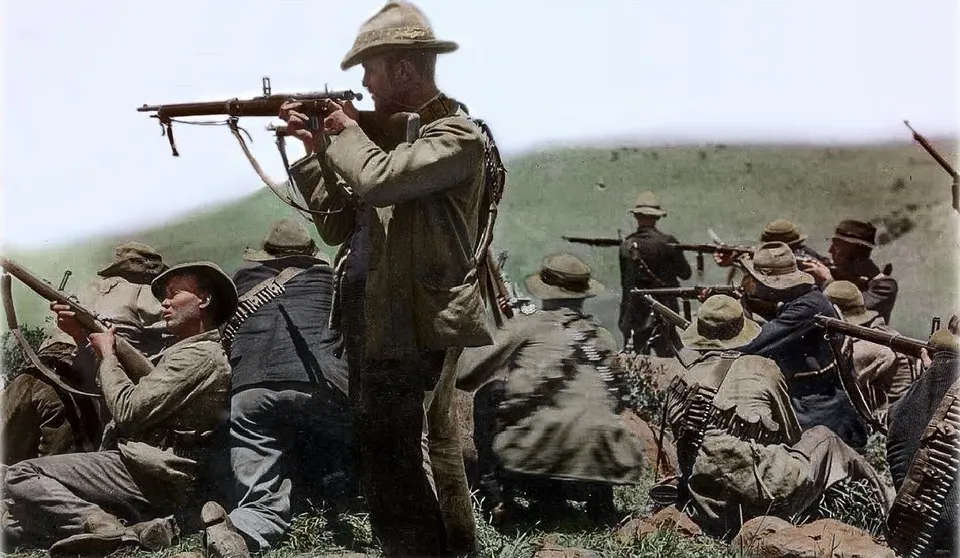
Unnamed War Correspondent · Public domain · Source
The Boers (Afrikaners), descendants of Dutch settlers, had left Britain’s Cape Colony and founded the Transvaal and the Orange Free State in the interior. When huge gold deposits were found in the Transvaal in 1886, British prospectors poured in, and Cecil Rhodes, prime minister of the Cape and champion of the Cape-to-Cairo vision, tried to topple the Transvaal government (the Jameson Raid, 1895–1896).
When war began on 11 October 1899 the Boers won a string of early victories and besieged Mafeking, Ladysmith and Kimberley. Britain sent a huge army and took Pretoria in June 1900, but when the Boers turned to guerrilla warfare the British burned farms and confined women and children in concentration camps, where more than 20,000 Boers and tens of thousands of Africans died of disease and hunger.
By the Treaty of Vereeniging of 31 May 1902 the two republics were annexed to Britain, and in 1910 the Union of South Africa was formed as a self-governing dominion. Feeling its international isolation during the war, Britain abandoned "splendid isolation" and concluded the Anglo-Japanese Alliance in 1902.