World history1839 – 191425 events

Imperialism and the Partition of the World

From the Tanzimat to Sarajevo — seventy-five years in which the powers carved up West Asia, India, Southeast Asia, Africa and the Pacific, and the peoples there answered with reform and resistance

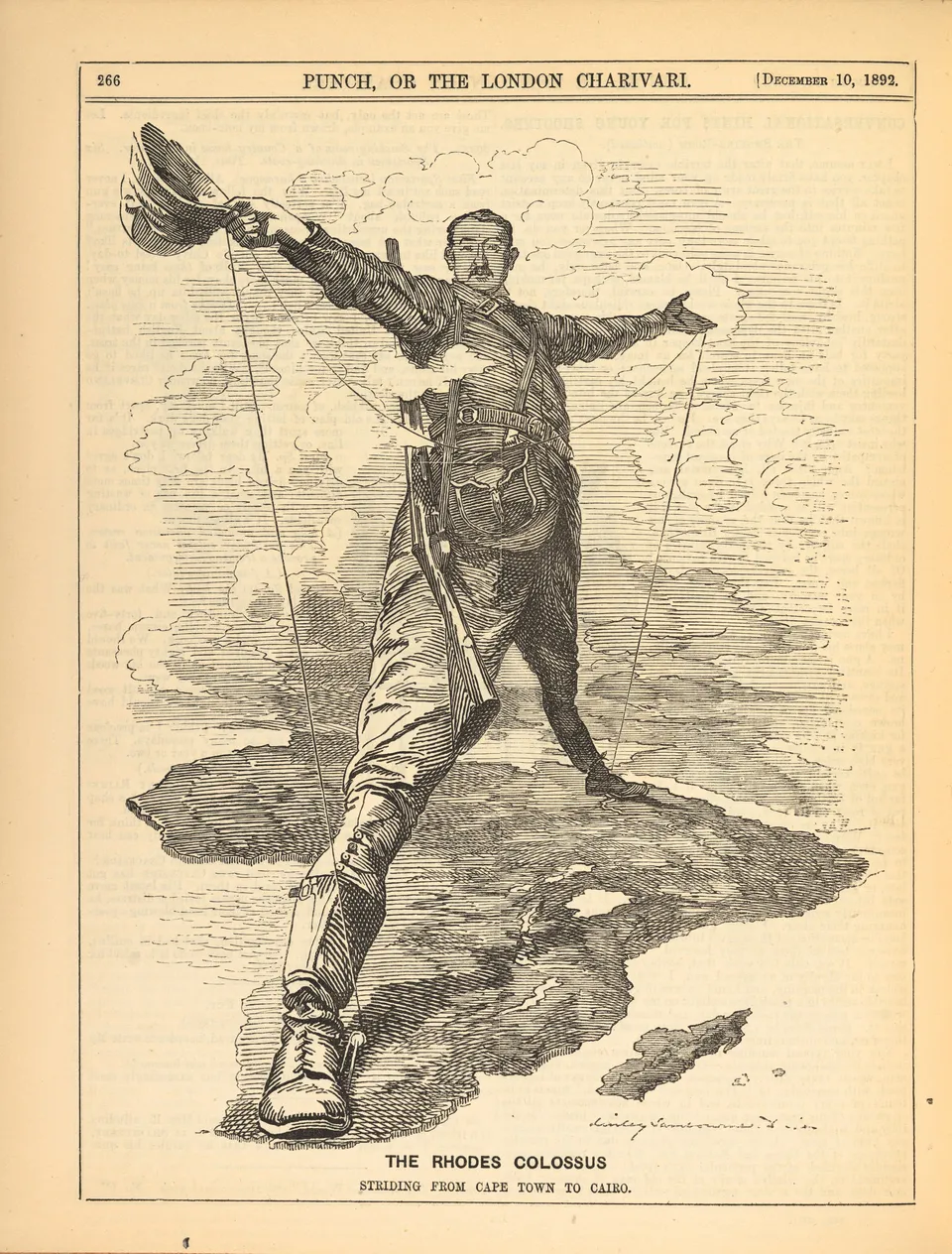
케이프타운에서 카이로까지 아프리카를 가로지르는 세실 로즈 — 영국 잡지 『펀치』의 만평 "로즈의 거상", 1892년

Edward Linley Sambourne · Public domain · Source

At a glance

YearRegionEventKey points
1839Ottoman EmpireTanzimat (reform)Edict of Gülhane, equality before law
1857IndiaRebellion of 1857 (resistance)Mughals end → direct British rule
1876Ottoman EmpireMidhat constitution (reform)Parliament → suspended by sultan
1878BalkansCongress of Berlin (powers)Russia checked; Serbia etc. independent
1881–82EgyptUrabi revolt (resistance)"Egypt for Egyptians" → British rule
1884–85AfricaBerlin Conference (powers)Effective occupation; Congo Free State
1887Southeast AsiaFrench Indochina (powers)Vietnam, Cambodia (+Laos); Siam a buffer
1891IranTobacco protest (resistance)Merchants and clergy; concession cancelled
1896EthiopiaBattle of Adwa (resistance)Italy defeated; independence kept
1898Philippines, CubaSpanish–American War (powers)US takes Philippines, Guam, Puerto Rico
1898SudanFashoda (powers)British N–S vs French E–W → France yields
1899–1902South AfricaBoer War (powers)Gold; concentration camps → British rule
1905–11IranConstitutional Revolution (reform)Majlis, constitution → crushed by UK, Russia
1905IndiaPartition of Bengal (powers)Calcutta resolutions → revoked 1911
1908Ottoman EmpireYoung Turk Revolution (reform)Constitution restored; Turkish nationalism
1911–12ChinaXinhai RevolutionThree Principles; Qing falls, Republic

The theme on the map

OpenFreeMap © OpenMapTiles © OpenStreetMap contributors

25 events in this theme

  1. 1839 – 1876Tanzimat Reforms

    With the Edict of Gülhane the Ottoman Empire began Western-style modernizing reforms, guaranteeing the life and property of all subjects regardless of religion and promising equality before the law.

  2. Indian soldiers (sepoys) of the British East India Company rose up, and people of every class joined as the revolt spread across northern India. Britain crushed it, abolished the Mughal Empire and took India under direct rule.

  3. The Suez Canal linking the Mediterranean and the Red Sea opened, greatly shortening the sea route from Europe to Asia.

  4. The Ottoman constitution drafted by the reforming grand vizier Midhat Pasha was proclaimed and a parliament met. But the sultan soon suspended both, using the Russo-Turkish War as a pretext.

  5. Russia defeated the Ottoman Empire in the name of the Balkan Slavs, but at the Congress of Berlin, called because Britain and Austria objected, its southward advance was checked again.

  6. The officer Ahmed Urabi rose against foreign interference and the khedive under the slogan "Egypt for the Egyptians" but was crushed by British troops. Egypt became a British protectorate in all but name.

  7. After Germany, Austria-Hungary and Italy formed the Triple Alliance (1882), Britain, France and Russia drew together step by step into the Triple Entente (1907). The European powers split into two camps.

  8. The powers met in Berlin to set the rules for dividing Africa. Within thirty years all of Africa except Ethiopia and Liberia had become European colonies.

  9. 1885 – 1887Geomundo Incident

    Claiming to block Russia’s southward advance, the Royal Navy occupied the island of Geomundo without Korea’s consent, leaving after two years through Qing mediation.

  10. With British support, Indian intellectuals convened the Indian National Congress in Bombay. Moderate at first, it later became the centre of the Indian national movement.

  11. Having taken Vietnam and Cambodia step by step, France joined them into the Indochinese Union; Laos was added later.

  12. When the Qajar shah granted a tobacco monopoly to a British subject, merchants and Muslim clergy led a nationwide boycott and won the concession back.

  13. Menelik II of Ethiopia decisively defeated an invading Italian army at Adwa. Ethiopia kept its independence through the partition of Africa.

  14. Intervening in Cuba’s war of independence, the US defeated Spain and took the Philippines, Guam and Puerto Rico. The Philippines declared independence but became an American colony after a war with the US.

  15. After American planters overthrew the Hawaiian Kingdom, the US annexed Hawaii during the Spanish–American War.

  16. British forces pushing north–south across Africa and French forces pushing east–west met at Fashoda in Sudan. France backed down, war was avoided, and the two later came to terms.

  17. Britain fought to take the gold-rich Boer republics of the Transvaal and the Orange Free State. It won at great cost and gained control of South Africa.

  18. 1904 – 1905Russo-Japanese War

    Japan and Russia fought over Korea and Manchuria. Victorious Japan won recognition of its exclusive control over Korea in the Treaty of Portsmouth.

  19. Phan Bội Châu sent young Vietnamese to study in Japan to train leaders against France. It ended when Japan came to terms with France.

  20. Merchants, clergy and intellectuals rose against Qajar despotism and foreign concessions and won a constitution and a parliament, but British and Russian interference brought the revolution down.

  21. When Britain split Bengal, heartland of Indian nationalism, into Hindu- and Muslim-majority halves, the Indian National Congress answered with four resolutions: boycott, swadeshi, swaraj and national education.

  22. Young officers and intellectuals of the Committee of Union and Progress rose and forced Sultan Abdulhamid II to restore the Midhat constitution. The next year they deposed him.

  23. Beginning with the Wuchang Uprising, revolution spread until the Republic of China was founded and the Qing fell. Over two thousand years of imperial rule ended, and China’s first republic was born.

  24. Gavrilo Princip, a young Bosnian Serb, shot dead the Austrian heir and his wife on their visit to Sarajevo. The killing set off the First World War.

  25. 1914 – 1918World War I

    Triggered by the assassination in Sarajevo, the European powers fought in two blocs. Four empires collapsed.

Key people

  • Abdulhamid II1842 – 1918

    Ottoman sultan (1876–1909) who granted a constitution, soon suspended it and ruled as an autocrat for thirty years

  • Otto von Bismarck1815 – 1898

    Minister-president of Prussia (1862–1890) and first chancellor of the German Empire (1871–1890) who unified Germany through three wars by his policy of “blood and iron”

  • Mustafa Reşid Pasha1800 – 1858

    Ottoman diplomat and grand vizier who read out the Edict of Gülhane in 1839 and led the Tanzimat reforms

  • Ferdinand de Lesseps1805 – 1894

    French diplomat and entrepreneur who won the concession for the Suez Canal from Egypt and opened it in 1869

  • Midhat Pasha1822 – 1884

    Ottoman reforming statesman and grand vizier who drafted the Ottoman constitution of 1876 (the Midhat constitution)

  • Alexander II of Russia1818 – 1881

    Emperor of Russia (1855–1881) who, after defeat in the Crimean War, emancipated the serfs and pursued reform from above, but was assassinated by revolutionaries

  • Ahmed Urabi1841 – 1911

    Egyptian officer who led the Urabi revolt (1881–1882) against foreign control and the khedive under the slogan "Egypt for the Egyptians"

  • Yu Gil-jun1856 – 1914

    Studied in Japan and the US after the 1881 inspection mission and the 1883 mission to America; wrote "Observations on a Journey to the West" and took part in the Gabo and Eulmi reforms

  • Menelik II1844 – 1913

    Emperor of Ethiopia (1889–1913) who defeated Italy at Adwa and preserved Ethiopian independence

  • Emilio Aguinaldo1869 – 1964

    Leader of the Philippine Revolution who declared independence in 1898 and, as president of the Philippine Republic, fought Spain and then the US

  • Liliʻuokalani1838 – 1917

    Last monarch of the Hawaiian Kingdom (1891–1893), deposed in a coup by American planters

  • Cecil Rhodes1853 – 1902

    British mining magnate and prime minister of the Cape Colony who championed the Cape-to-Cairo vision; Rhodesia was named after him