Ssireum
Also called: Korean wrestling
A traditional contest of strength and skill in which wrestlers grip each other’s satba belts and try to throw each other. It is depicted in the Goguryeo Gakjeochong mural, and in 2018 it became the first heritage jointly inscribed by South and North Korea on the list of Intangible Cultural Heritage of Humanity.
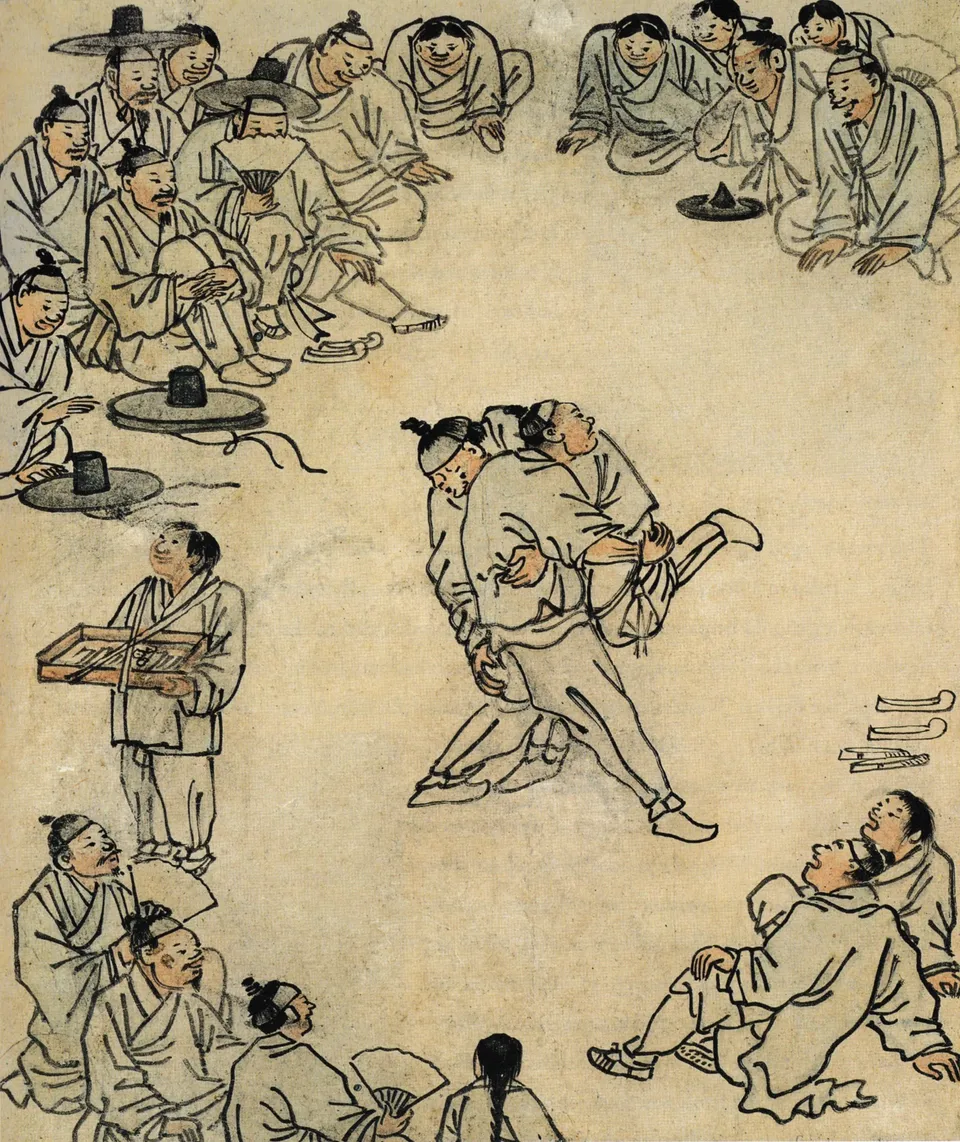
단원 김홍도 (檀園 金弘道, 1745 - 1816 이후) · Public domain · Source
Ssireum is a game and sport in which two people grip the satba belts tied around each other’s waist and thigh and contest with strength and skill; whoever makes the opponent’s body touch the ground first wins. A mural in the Goguryeo tomb Gakjeochong at Ji’an shows two men grappling, so the tomb is also called the "Wrestlers’ Tomb". One of them, with large eyes and a high nose, is sometimes taken to be a man from Central Asia.
There are records of ssireum in Goryeo too, and in Joseon every village held bouts on holidays such as Dano and Baekjung, the winner sometimes taking home a bull as a prize. Kim Hong-do’s genre painting Ssireum vividly captures even the onlookers around the ring.
In 2018 "Traditional Korean wrestling (Ssirum/Ssireum)", nominated jointly by South and North Korea, was inscribed by UNESCO as Intangible Cultural Heritage of Humanity, the first heritage the two Koreas inscribed together.