The Temple of Zeus at Olympia and Phidias’ Statue of Zeus
Also called: Statue of Zeus at Olympia, Temple of Zeus, Olympia
Around 470–456 BC the architect Libon of Elis built the Temple of Zeus in the sanctuary of Olympia, and around 435 BC Phidias made for it a seated statue of Zeus in gold and ivory, some 12 m tall, counted among the Seven Wonders of the ancient world.
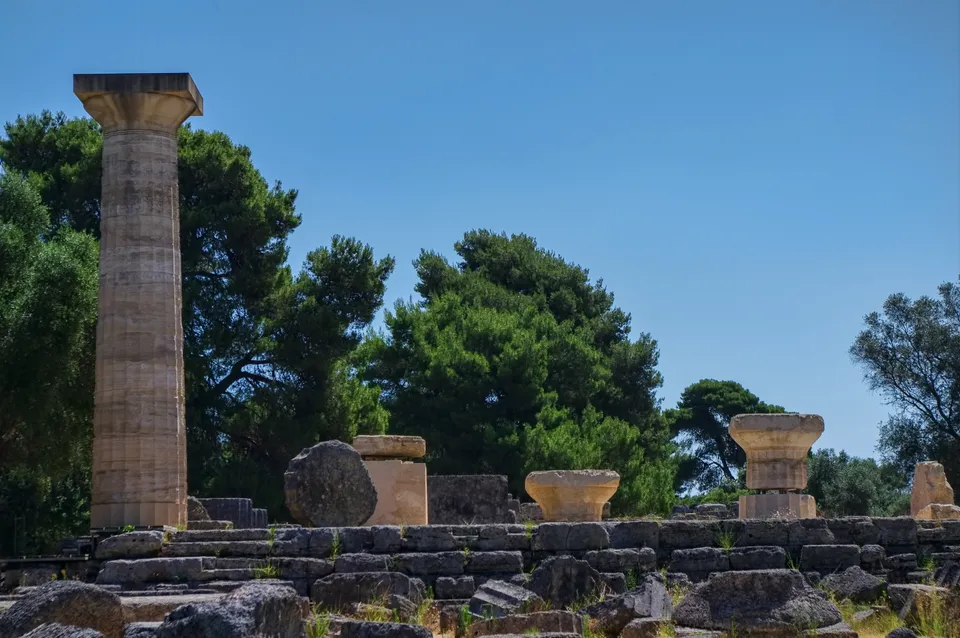
Michael Nicht · CC BY-SA 4.0 · Source
At Olympia, the sanctuary of Zeus where the Olympic Games were held, the people of Elis built a great Doric temple of Zeus around 470–456 BC to the design of the architect Libon. The east pediment showed the chariot race of Pelops and Oenomaus, the west pediment the battle of the Lapiths and Centaurs, and the metopes the twelve labours of Heracles; these sculptures are now in the Archaeological Museum of Olympia.
Having finished the Athena of the Parthenon, Phidias came to Olympia and around 435 BC made the seated Zeus inside the temple, some 12 m tall, of ivory and gold plates over a wooden frame, holding a Nike (Victory) in his right hand and a sceptre topped by an eagle in his left. It was counted among the Seven Wonders of the ancient world, but no copy survives and its appearance is known only from coins and ancient descriptions. In 1954–1958 the German Archaeological Institute excavated Phidias’ workshop, finding moulds for the statue’s drapery and a cup inscribed “I belong to Phidias”, though some scholars doubt the inscription.
How the statue was lost is uncertain: perhaps when the temple burned around 425, or, according to the 11th-century Byzantine historian Cedrenus, after it was taken to Constantinople, in the fire of the Palace of Lausus in 475. The temple was long thought to have been toppled by 6th-century earthquakes, though one study argues its columns were deliberately pulled down. Olympia became a UNESCO World Heritage Site in 1989.