Myths800 BC – 432 BC18 events

The Olympian Gods

From Chaos and Gaia to the War of the Titans, the reign of Zeus, Prometheus and Pandora — the gods of Greek myth in story order, alongside Hesiod’s Theogony and the real sanctuaries where the myths lived: Eleusis, Delphi, the Parthenon and Olympia
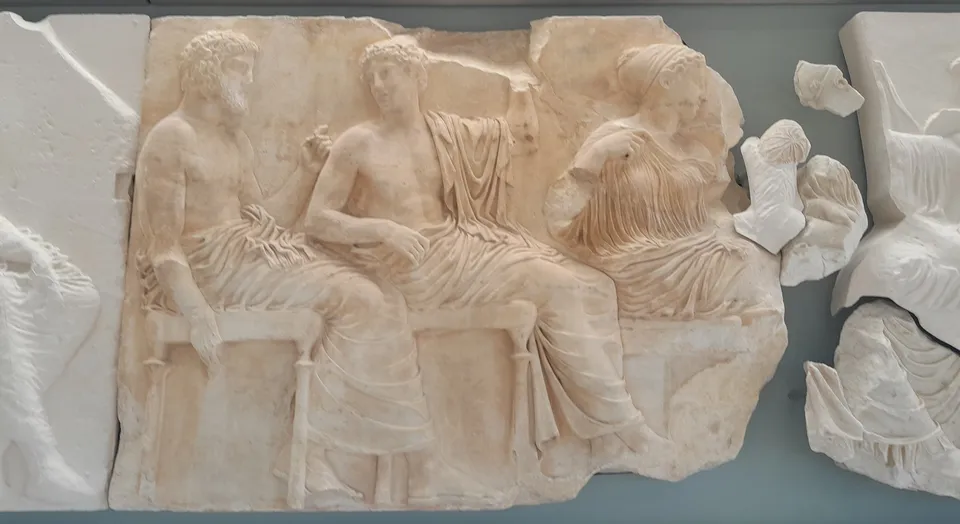
파르테논 동쪽 띠 조각에 앉은 올림포스의 신들 — 포세이돈·아폴론·아르테미스, 기원전 443 – 438년 무렵. 아테네 아크로폴리스 박물관

Deiadameian · CC BY-SA 4.0 · Source

At a glance

StorySourceKind
Chaos, Gaia and UranusHesiod, TheogonyMyth
Cronus and the birth of ZeusTheogony; ApollodorusMyth
War of the TitansTheogonyMyth
Dividing the worldIliad 15Myth
The Theogony (c. 700 BC)Ascra in Boeotia; HesiodHistory
Birth of AthenaTheogony; Homeric Hymn 28Myth
Prometheus’ fireTheogony; Works and Days; AeschylusMyth
Pandora’s boxWorks and DaysMyth
Five ages of manWorks and DaysMyth
Deucalion’s floodApollodorus; Ovid, Metamorphoses 1Myth
Hades and PersephoneHomeric Hymn 2, to DemeterLegend
Eleusinian Mysteries (7th c. BC – AD 392)Sanctuary of EleusisHistory
Apollo and PythonHomeric Hymn 3, to ApolloLegend
Oracle of Delphi (from 8th c. BC)Sanctuary of Apollo, DelphiHistory
DionysusHomeric Hymns; Euripides, BacchaeMyth
Athena and Poseidon’s contestHerodotus; ApollodorusLegend
Building of the Parthenon (447–432 BC)Pericles; PhidiasHistory
Temple and statue of Zeus at OlympiaLibon; PhidiasHistory

The theme on the map

OpenFreeMap © OpenMapTiles © OpenStreetMap contributors

18 events in this theme

  1. A Greek myth told in Hesiod’s Theogony. First came Chaos (the Gap), then Gaia the Earth, Tartarus and Eros. Uranus, the Sky born of Gaia, imprisoned his children inside the earth until his youngest son Cronus overthrew him.

  2. A Greek myth told in Hesiod’s Theogony. Fearing a prophecy that a son would overthrow him, Cronus, king of the Titans, swallowed each child his wife Rhea bore. Rhea gave him a stone in swaddling clothes in place of her youngest, Zeus, and hid Zeus on Crete.

  3. A Greek myth told in Hesiod’s Theogony. Zeus and his siblings on Mount Olympus fought Cronus and the Titans on Mount Othrys for ten years. With the thunderbolt forged by the Cyclopes and the help of the Hundred-Handers, Zeus won and shut the Titans in Tartarus.

  4. A Greek myth told in Book 15 of Homer’s Iliad. After defeating the Titans, the three sons of Cronus cast lots: Zeus won the sky, Poseidon the sea and Hades the underworld, while the earth and Olympus were shared by all.

  5. Around 700 BC the Boeotian poet Hesiod composed the Theogony, on the beginning of the world, the generations of the gods and how Zeus became king. With his Works and Days, it is the oldest systematic account of Greek myth.

  6. UndatedThe Birth of AthenaLegend

    A Greek myth told in Hesiod’s Theogony and the Homeric Hymns. Fearing that Metis, goddess of wisdom, would bear a son mightier than himself, Zeus swallowed her; later Athena sprang fully armed from Zeus’ head.

  7. A Greek myth told in Hesiod’s Theogony and Works and Days and in the tragedy Prometheus Bound attributed to Aeschylus. The Titan Prometheus stole the fire Zeus had hidden, carried it to mankind in a fennel stalk, and was chained to a rock where an eagle ate his liver every day.

  8. UndatedPandora’s BoxLegend

    A Greek myth told in Hesiod’s Works and Days and Theogony. Pandora, the first woman, made by the gods at Zeus’ command as punishment for the theft of fire, opened the lid of a great jar; every sickness and sorrow spread through the world, and only Hope remained inside.

  9. A Greek myth told in Hesiod’s Works and Days. Mankind declined from the Golden Age under Cronus through the ages of silver, bronze and the heroes to the hard Iron Age in which Hesiod himself lived.

  10. UndatedDeucalion’s FloodLegend

    A Greek myth told in Apollodorus’ Library and Ovid’s Metamorphoses. When Zeus sent a great flood to wipe out the wicked bronze race, only Deucalion, son of Prometheus, and his wife Pyrrha survived in an ark, and they remade mankind by throwing stones.

  11. A Greek myth told in the Homeric Hymn to Demeter. When Hades, god of the underworld, carried off Demeter’s daughter Persephone, Demeter searched for her and, staying at Eleusis, kept the grain from growing. In the end Persephone was to spend part of each year in the underworld.

  12. For more than a thousand years, secret rites in honour of Demeter and Persephone were held at the sanctuary of Eleusis north-west of Athens. Initiates swore never to reveal what they had seen, and the heart of the rite is still unknown.

  13. 800 BCApollo and PythonLegend

    A Greek myth told in the Homeric Hymn to Apollo. Apollo shot the great serpent (Python) that guarded the spring at Delphi and founded his oracle on the spot. The name of the Delphic priestess, the Pythia, comes from this story.

  14. From about the 8th century BC the Pythia, priestess of Apollo, gave oracles at Delphi on the slopes of Mount Parnassus. Greek cities and foreign kings came to consult her before founding colonies or going to war, and the place was held to be the “navel” of the Greek world.

  15. A Greek myth told in Hesiod’s Theogony, the Homeric Hymns and Euripides’ tragedy The Bacchae. Dionysus, son of Zeus and the mortal Semele, was born from Zeus’ thigh after his mother was burned to death, and wandered the world teaching the making of wine until he was accepted as a god.

  16. A Greek myth told by Herodotus, Apollodorus’ Library and Ovid’s Metamorphoses. Athena and Poseidon competed to be patron of Athens: Poseidon brought forth a salt spring on the Acropolis and Athena an olive tree, and Athena won.

  17. 447 BC – 432 BCBuilding of the Parthenon

    In 447 BC Athens under Pericles began a temple to Athena Parthenos (Athena the Virgin) on the Acropolis; it was dedicated in 438 BC and its sculpture finished in 432 BC. The sculptor Phidias directed the work and its sculpture.

  18. Around 470–456 BC the architect Libon of Elis built the Temple of Zeus in the sanctuary of Olympia, and around 435 BC Phidias made for it a seated statue of Zeus in gold and ivory, some 12 m tall, counted among the Seven Wonders of the ancient world.

Key people

  • Phidias

    Sculptor of ancient Athens (c. 480 – c. 430 BC). A friend of Pericles, he oversaw the building and sculpture of the Parthenon and made the gold-and-ivory Athena Parthenos and the Statue of Zeus at Olympia

  • Hesiod

    Ancient Greek poet of the Theogony and the Works and Days, who lived at Ascra in Boeotia around 700 BC; with Homer, the oldest source of Greek myth

  • Pericles429 BC

    Statesman of Athens at its height who led the city for some thirty years, completed its direct democracy and built the Parthenon