Theseus and the Minotaur
Also called: Minotaur, Labyrinth, Ariadne’s thread
A legend handed down over the centuries.
A Greek myth and legend told in Plutarch’s Life of Theseus, Apollodorus and Ovid, among others. Theseus, prince of Athens, killed the bull-headed Minotaur shut in the Labyrinth of King Minos of Crete, and found his way out by the thread given him by the princess Ariadne.
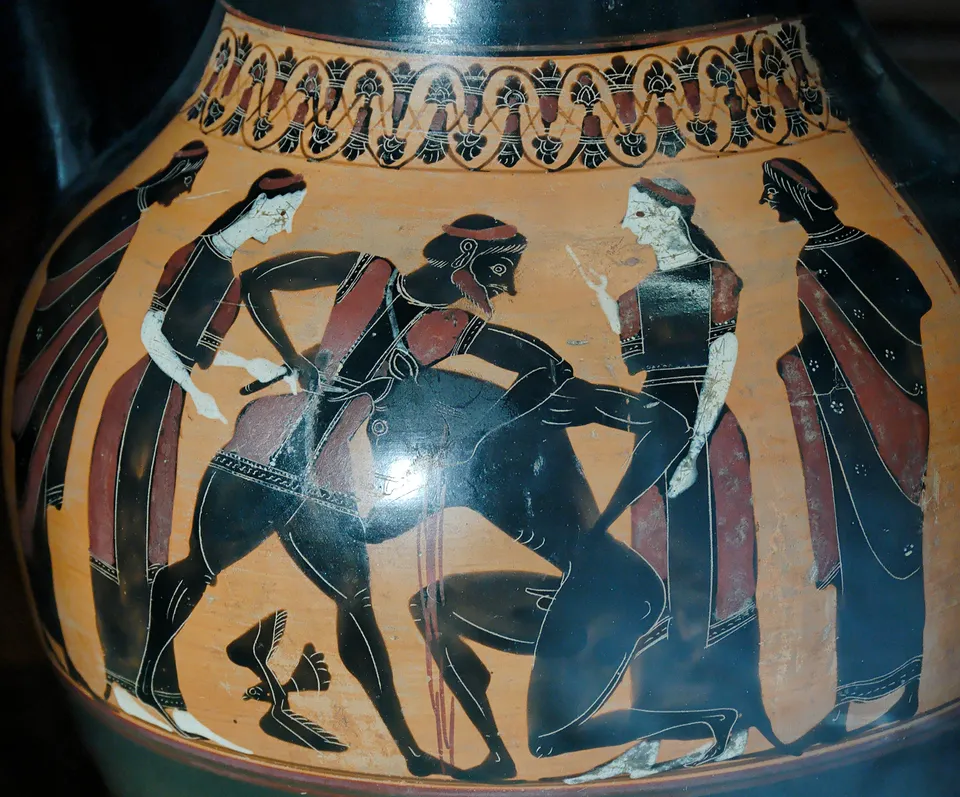
Group of London B 174 · Public domain · Source
This Greek myth and legend is told in Plutarch’s Life of Theseus, Apollodorus, Catullus and Ovid (Metamorphoses, Book 8), among others. Pasiphaë, wife of King Minos of Crete, bore the Minotaur, a man with a bull’s head, to a bull sent by Poseidon, and Minos had the craftsman Daedalus build the Labyrinth, a maze no one could escape, to hold him. When Minos’ son Androgeus was killed near Athens, Minos attacked the city and made it send seven young men and seven maidens every nine years (or every year) to be devoured by the Minotaur.
Theseus, son of King Aegeus of Athens, volunteered to go among the victims. Ariadne, Minos’ daughter, fell in love with him and, on Daedalus’ advice, gave him a ball of thread; unwinding it, Theseus went deep into the Labyrinth, killed the Minotaur and followed the thread back out. But he forgot his promise to hoist a white sail as a sign of victory, and Aegeus, seeing the black sail, threw himself into the sea, which was called the Aegean after him.
The maze-like rooms of the palace of Knossos, frescoes of bull-leaping, horns of consecration and double-axe (labrys) signs have long been read alongside the story. Some link the word “labyrinth” to the labrys or to a word on Linear B tablets from Knossos (da-pu₂-ri-to-jo), but this is not settled. Here the legend is placed at Knossos, but it has no fixed date.