The Citadel of Tiryns
Also called: Cyclopean walls of Tiryns
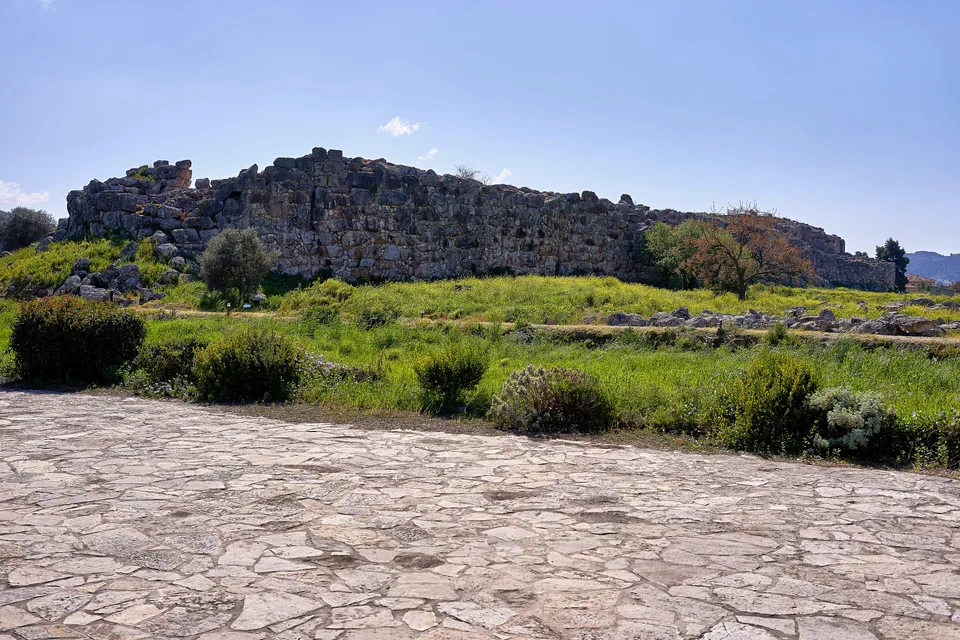
In the 14th–13th centuries BC a Mycenaean citadel rose at Tiryns in the Argolid. Its walls of huge stones, about six metres thick, were so massive that they were said to be the work of the one-eyed giants, the Cyclopes — hence “Cyclopean” walls. The palace fell around 1200 BC.
George E. Koronaios · CC BY-SA 4.0 · Source
Tiryns is a Mycenaean citadel on a low rocky hill in the plain of the Argolid. It grew in three stages from the 15th century BC, and most of what is visible today dates to the 13th century BC. The walls are usually about six metres thick, rising to seventeen where passages and chambers run through them. The corbel-vaulted galleries inside the northern walls are thought to have sheltered people from the lower town in times of danger. The palace had a great hall (megaron) and frescoes such as a boar hunt.
The 2nd-century traveller Pausanias wrote that even the smaller stones could not be moved by a pair of mules, and that, as legend said, the Cyclopes had built the walls for King Proetus. In Greek myth Tiryns was ruled by Perseus, and it was where Heracles carried out his twelve labours at the command of King Eurystheus.
The palace was destroyed around 1200 BC, though the lower town went on growing for a time. Schliemann made trial digs in 1876 and excavated in earnest with Dörpfeld in 1884, and the German Archaeological Institute has continued the work since. Tiryns became a UNESCO World Heritage Site together with Mycenae in 1999.