PoliticsNovember 1919

Uiyeoldan (Heroic Corps)

Kim Won-bong founded the Uiyeoldan at Jilin in Manchuria to destroy key Japanese institutions and assassinate officials.
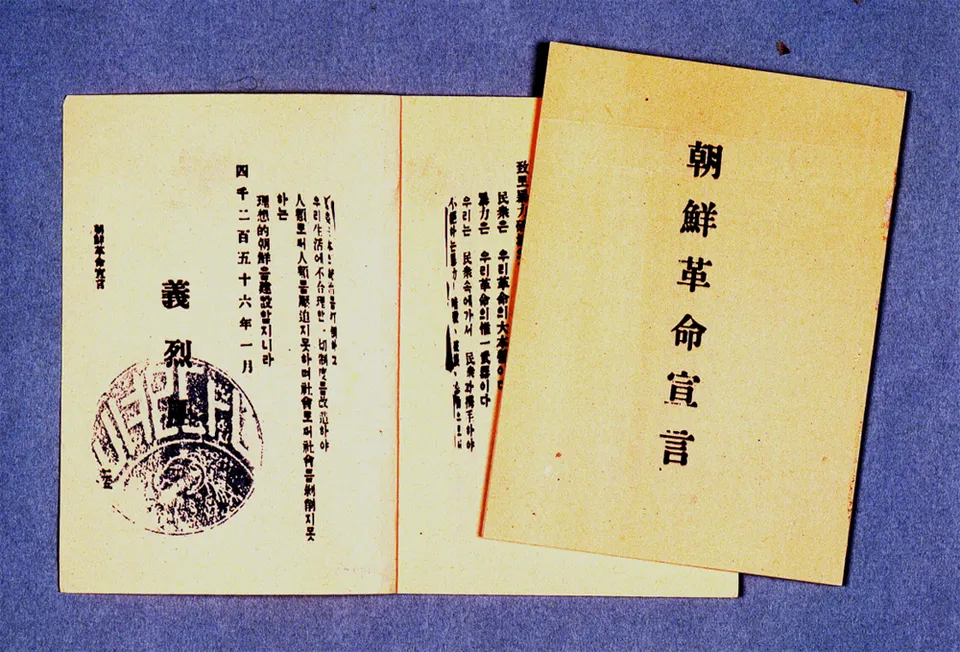
Declaration of Joseon Revolution — the Uiyeoldan manifesto written by Shin Chae-ho in 1923

Shin Chae-ho · Public domain · Source

Founded in November 1919, it targeted "seven to be killed" (senior officials, army chiefs, collaborators and others) and "five to be destroyed" (the Government-General, the Oriental Development Company, police stations and others). Its attacks included Park Jae-hyeok’s bombing of Busan police station (1920), Kim Ik-sang’s bomb at the Government-General (1921), Kim Sang-ok’s at Jongno police station (1923), Kim Ji-seop’s at the Imperial Palace in Tokyo (1924) and Na Seok-ju’s at the Oriental Development Company and Chosen Industrial Bank (1926).

In 1923 Sin Chae-ho wrote its manifesto, the Declaration of the Korean Revolution, rejecting diplomacy, gradualism and home rule in favour of "direct revolution by the people" and violent struggle. Aware of the limits of individual attacks, members entered the Whampoa Military Academy in 1926, opened a cadre school in Nanjing in 1932 and led the founding of the National Revolutionary Party in 1935.

The map in 1919

OpenFreeMap © OpenMapTiles © OpenStreetMap contributors

States and rulers at the time
Republic of China
Japan · targeted — Emperor Taishō

People

  • Kim Won-bong1898 – 1958

    leader · Leader of the Uiyeoldan, the National Revolutionary Party and the Korean Volunteer Corps; Deputy Commander of the Liberation Army

  • Sin Chae-ho1880 – 1936

    author · Nationalist historian who wrote the Ancient History of Joseon and the Declaration of the Korean Revolution; died in Lüshun Prison

  • Kim Sang-ok1890 – 1923

    participant · Uiyeoldan member who bombed Jongno police station in 1923 and took his own life after a gunfight with the Japanese police

  • Na Seok-ju1892 – 1926

    participant · Uiyeoldan member who bombed the Oriental Development Company and the Chosen Industrial Bank in Seoul in 1926 and then shot himself

Before and after

Earlier
1919 "Cultural Rule"

Related works

Dramatized works (films, dramas, novels) may differ from the historical record.

Themes that include this event

  • Republican China and Imperial Japan1912 – 1949

    The age when the Republic of China, born of the 1911 Revolution, passed through warlord division, the May Fourth Movement, the United Front and the Northern Expedition, fought Japan’s invasion and split in civil war — as Japan moved from Taishō democracy through the Manchurian Incident and military coups to the war in China and the Co-Prosperity Sphere, and colonized Korea resisted through the March First Movement and armed struggle