Currency Reform in Western Germany
Also called: Introduction of the Deutsche Mark, Währungsreform
The American, British and French zones replaced the worthless Reichsmark with the Deutsche Mark. Goods returned to the shops and the economy revived, but the Soviet Union answered with the Berlin Blockade and the division of Germany hardened.
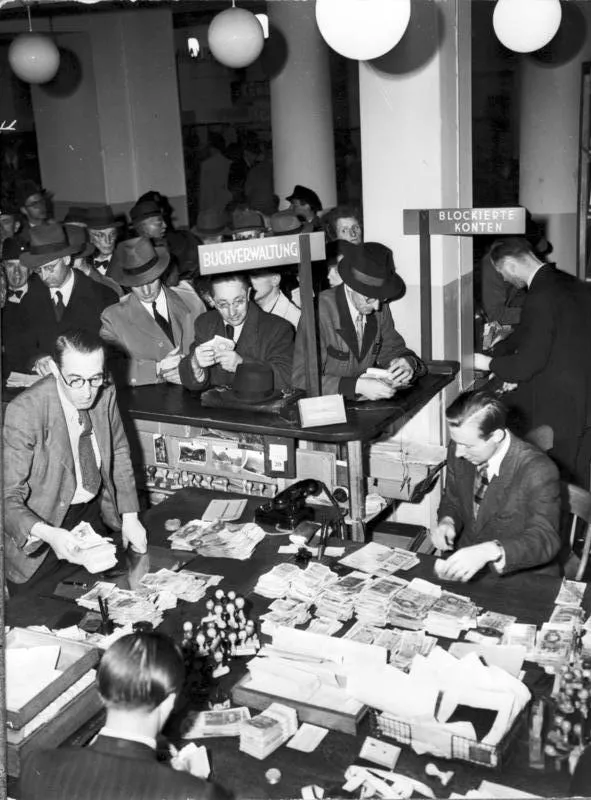
Bundesarchiv, Bild 147-0739 / o. Ang. · CC BY-SA 3.0 de · Source
After the war the Reichsmark had all but lost its value; cigarettes served as money and black markets flourished. On 20 June 1948 the three Western occupying powers introduced a new currency, the Deutsche Mark. Each person first received 40 marks, while old cash and savings were converted at a steep discount. At the same time the economic administrator Ludwig Erhard lifted much of the price control.
Hoarded goods appeared in the shops almost overnight, and together with Marshall aid the so-called “economic miracle” began. The Soviet Union introduced its own currency in its zone and on 24 June cut the routes to West Berlin (the Berlin Blockade). With two currencies, the Potsdam idea of treating Germany as one economic unit was effectively dead.