Germany · History1945 – 199022 events

The Division and Reunification of Germany

From Potsdam to 3 October 1990 — how a Germany occupied by four powers split into East and West, and reunited after 45 years
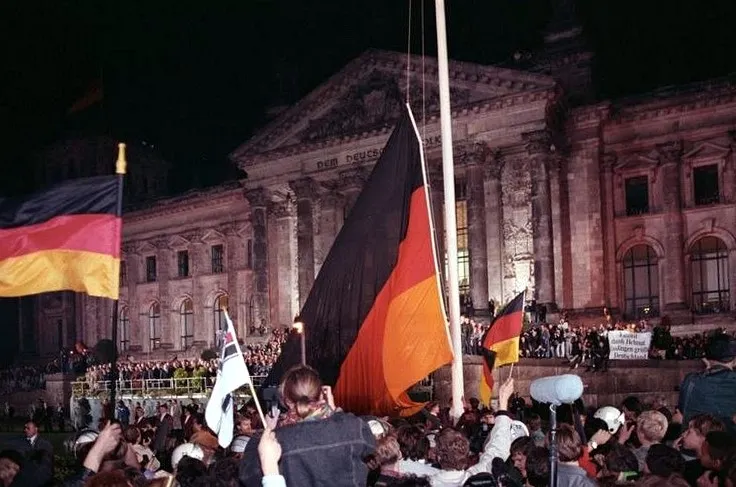
통일의 날 밤 베를린 제국 의회 의사당 앞에 모인 시민들 — 페어 그림 사진, 1990년 10월 3일, 독일 연방 기록 보관소

Bundesarchiv, Bild 183-1990-1003-400 / Peer Grimm · CC BY-SA 3.0 de · Source

At a glance

West GermanyEast Germany
Official nameFederal Republic of Germany (FRG)German Democratic Republic (GDR)
Founded23 May 1949 (Basic Law)7 October 1949
CapitalBonn (provisional)East Berlin
PoliticsParliamentary democracy, federalOne-party rule of the SED
EconomySocial market economyPlanned economy
AllianceNATO (1955)Warsaw Pact (1955)
LeadersAdenauer, Brandt, KohlUlbricht, Honecker
UN membership1973 (134th)1973 (133rd)
Population (c. 1989)c. 62 millionc. 16 million

The theme on the map

OpenFreeMap © OpenMapTiles © OpenStreetMap contributors

22 events in this theme

  1. Truman, Stalin and Churchill (later Attlee) settled the treatment of defeated Germany at Potsdam. During the conference the US, Britain and China issued the Potsdam Declaration demanding Japan’s unconditional surrender.

  2. 1945 – 1946Nuremberg Trials

    An international military tribunal set up by the US, Britain, France and the Soviet Union tried the leaders of Nazi Germany for aggressive war, war crimes and crimes against humanity; twelve were sentenced to death.

  3. The United States declared a policy of containing communism (the Truman Doctrine) and offered massive aid to rebuild Western Europe (the Marshall Plan). The Cold War began in earnest.

  4. The American, British and French zones replaced the worthless Reichsmark with the Deutsche Mark. Goods returned to the shops and the economy revived, but the Soviet Union answered with the Berlin Blockade and the division of Germany hardened.

  5. 1948 – 1949Berlin Blockade

    When the Soviet Union cut road, rail and water routes to West Berlin, the US and Britain supplied the city by air for eleven months (the Berlin Airlift). The next year Germany split into East and West.

  6. Delegates of the Western zones drafted the Basic Law in Bonn and the Federal Republic of Germany came into being; in September Adenauer became its first chancellor.

  7. The German Democratic Republic was founded in the Soviet zone, with East Berlin as its capital and real power held by the Socialist Unity Party (SED) under Ulbricht.

  8. A strike by East Berlin construction workers spread into an uprising across East Germany. Soviet tanks crushed it, and West Germany commemorated 17 June as the “Day of German Unity”.

  9. When West Germany regained sovereignty and joined NATO, the Soviet Union, East Germany and the other Eastern European states formed the Warsaw Pact five days later. The two Germanys became the front line between two military blocs.

  10. Overnight, East Germany strung barbed wire and then built a wall between East and West Berlin. The Berlin Wall became the symbol of the Cold War and of division.

  11. Two years after the Wall went up, President Kennedy visited West Berlin and told hundreds of thousands gathered before Schöneberg Town Hall, “Ich bin ein Berliner”, pledging to stand by the city.

  12. West German Chancellor Willy Brandt suddenly knelt before the memorial to the Warsaw Ghetto Uprising, a gesture of atonement for Nazi crimes; the same day he signed a treaty with Poland accepting its border.

  13. As the culmination of Brandt’s Ostpolitik, the two German states signed the Basic Treaty, recognizing each other as equals and exchanging permanent missions — “change through rapprochement”.

  14. Following the Basic Treaty, East and West Germany became the 133rd and 134th members of the United Nations on the same day. The two Koreas joined together in the same way in 1991.

  15. During a peace rally on the Austrian border near Sopron, Hungary, a border gate opened briefly and several hundred East Germans crossed to the West — the first big breach in the Iron Curtain.

  16. After Monday prayers at Leipzig’s St. Nicholas Church, citizens took to the streets chanting “We are the people”. On 9 October some 70,000 marched and the regime did not use force — the turning point of the Peaceful Revolution.

  17. At a live press conference, SED Politburo spokesman Günter Schabowski mistakenly announced that new exit rules took effect “immediately”. East Berliners rushed to the checkpoints, and that night the Wall opened.

  18. East Germany opened its border and the Berlin Wall came down, a symbol of the end of the Cold War.

  19. East Germany elected its People’s Chamber in its first and last free election. The “Alliance for Germany”, promising rapid unification, won with 48 per cent.

  20. The West German mark became East Germany’s legal tender. Wages and pensions were converted one to one, but uncompetitive East German firms collapsed and unemployment soared.

  21. The two German states and the US, USSR, Britain and France signed the Treaty on the Final Settlement with Respect to Germany in Moscow, ending the victors’ rights and giving united Germany full sovereignty.

  22. East Germany joined the Federal Republic, reuniting Germany after 41 years.

Key people

  • Willy Brandt1913 – 1992

    Mayor of West Berlin (1957–1966) and chancellor of West Germany (1969–1974) whose Ostpolitik sought reconciliation with the East; Nobel Peace Prize 1971

  • Harry S. Truman1884 – 1972

    33rd US president (1945–1953) who ordered the atomic bombings, set the policy of containment with the Truman Doctrine and sent US forces to the Korean War

  • Konrad Adenauer1876 – 1967

    First chancellor of West Germany (1949–1963), who anchored it in the West, took it into NATO and championed European integration

  • Erich Honecker1912 – 1994

    Leader of East Germany (1971–1989) who had organized the building of the Berlin Wall and was ousted amid the protests of autumn 1989

  • Helmut Kohl1930 – 2017

    Chancellor of West Germany and reunited Germany (1982–1998), who steered the Two Plus Four talks to German unity in 1990

  • Joseph Stalin1878 – 1953

    General Secretary of the Soviet Communist Party who ruled the USSR from the late 1920s until his death, led the war against Germany and drew Eastern Europe into the Soviet bloc

  • Winston Churchill1874 – 1965

    British prime minister (1940–1945, 1951–1955) who led Britain’s resistance through the Battle of Britain and named the “Iron Curtain” in 1946

  • Walter Ulbricht1893 – 1973

    Leader of East Germany’s Socialist Unity Party (1950–1971), who built a Soviet-style state and the Berlin Wall in 1961

  • John F. Kennedy1917 – 1963

    35th US president (1961–1963) who resolved the Cuban Missile Crisis and launched the Apollo programme; assassinated in Dallas in 1963

  • George C. Marshall1880 – 1959

    US Army Chief of Staff in the Second World War and Secretary of State (1947–1949) who proposed the European Recovery Program (Marshall Plan); Nobel Peace Prize 1953

  • Nikita Khrushchev1894 – 1971

    First Secretary of the Soviet Communist Party (1953–1964) who denounced Stalin and preached peaceful coexistence, yet confronted the US over the Berlin Wall and Cuba

  • Günter Schabowski1929 – 2015

    East German Politburo member whose mistaken statement at a press conference on 9 November 1989 that new travel rules applied “immediately” opened the Wall