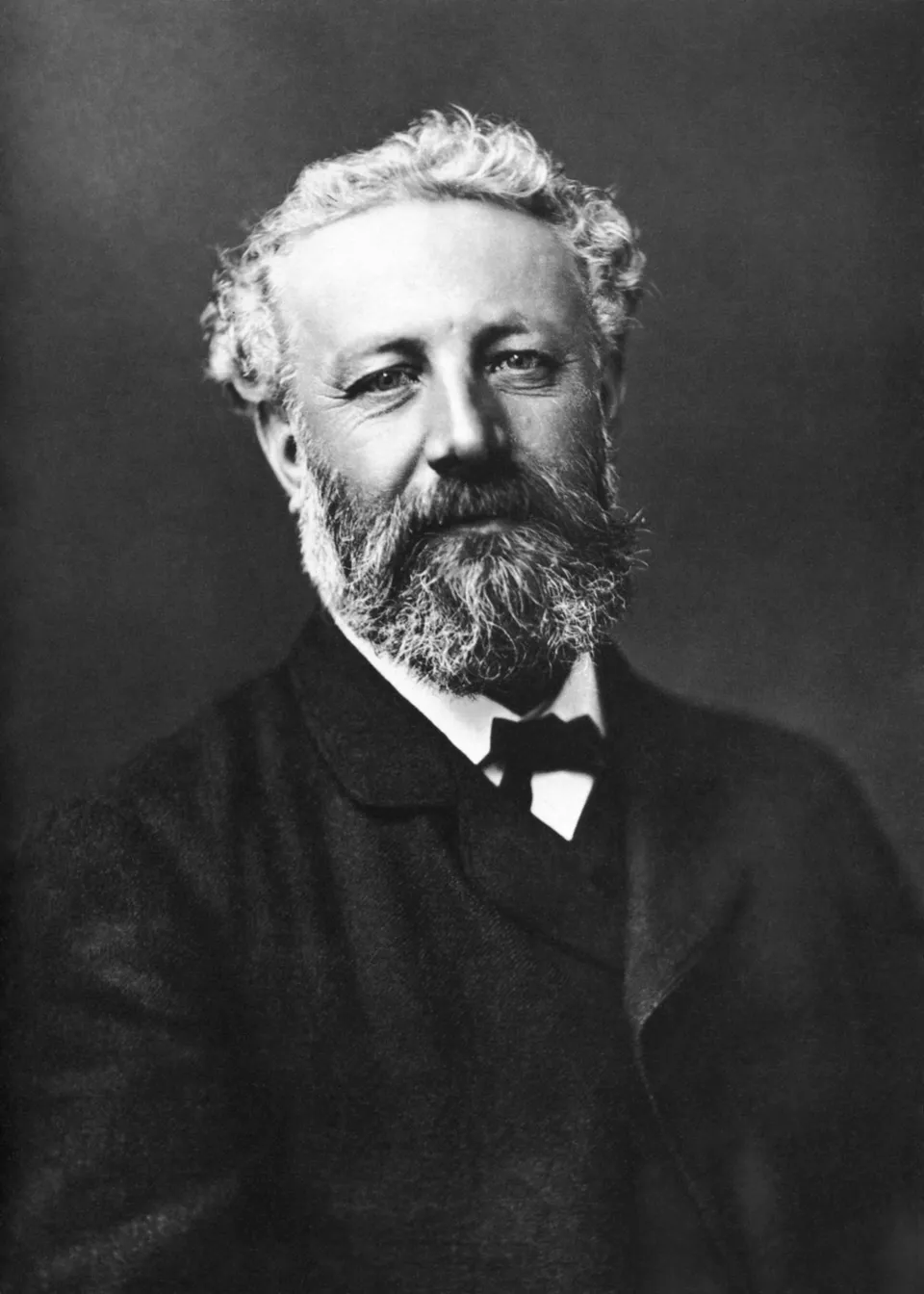
Nadar · Public domain · Source
Person1828 – 1905
Jules Verne
French novelist whose adventure stories such as Twenty Thousand Leagues Under the Seas and Around the World in Eighty Days made him a father of science fiction
Nadar · Public domain · Source
French novelist whose adventure stories such as Twenty Thousand Leagues Under the Seas and Around the World in Eighty Days made him a father of science fiction
Jules Verne’s novel of Captain Nemo’s submarine Nautilus travelling round the world beneath the sea appeared in a magazine. The twenty thousand leagues (about 80,000 km) are not a depth but the distance the Nautilus travels.
Jules Verne’s novel, in which the London gentleman Phileas Fogg wagers he can circle the globe in eighty days, appeared in a newspaper — a story of the years when the Suez Canal and the transcontinental railroad had just opened.
The American journalist Nellie Bly, out to beat the fictional Fogg, travelled alone eastward around the world and returned in 72 days, 6 hours and 11 minutes — the fastest circuit yet.

American journalist famed for her undercover exposé of an insane asylum, who travelled alone around the world in 72 days in 1889–90
When the Suez Canal and the transcontinental railroad made it possible to circle the globe in months — Phileas Fogg’s eighty days in Jules Verne’s novel, and the reporter Nellie Bly who took up the challenge and went round in seventy-two
Jules Verne’s novel of Captain Nemo’s submarine Nautilus circling the world beneath the sea — the treasure ships of Vigo Bay, La Pérouse’s wrecks, the giant squid and the Atlantic cable behind it, and the people who really reached the South Pole and passed under the North Pole after the novel went there first