The Reign of Akbar
Also called: Mansabdari system, Akbar the Great
The Mughal emperor Akbar united northern India and organised officials and army through the mansabdari system. By abolishing the jizya on non-Muslims and drawing Hindus into his service, he gave the empire its framework.
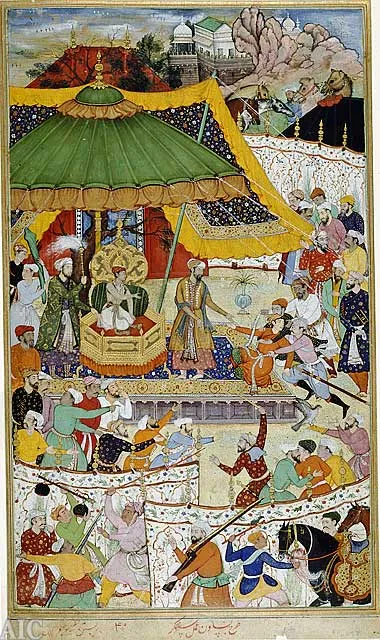
Basawan · Public domain · Source
Akbar came to the throne in 1556 at the age of thirteen, and that year his army defeated Hemu at the Second Battle of Panipat and recovered Delhi. He went on to subdue the Rajput kingdoms, Gujarat (1573), Bengal (1576) and Kashmir, bringing most of northern India under his rule. Under the mansabdari system every official and commander held a rank (mansab) that fixed the cavalry he maintained and his pay, and land was surveyed to put taxation on a regular footing. Persian became the language of government.
Akbar worked to win over the Hindus who made up most of his subjects. He married Rajput princesses, appointed Hindus to high office and in 1564 abolished the poll tax (jizya) on non-Muslims. At his new capital, Fatehpur Sikri, he built a House of Worship (Ibadat Khana) where Muslim, Hindu, Jain, Zoroastrian and Christian scholars debated, and he promoted a “Divine Faith” (Din-i Ilahi) drawing on many religions. Mughal painting and architecture, blending Persian and Indian styles, flourished, and an Indo-Islamic culture mixing Muslim and Hindu traditions grew up.
His rule gave the empire nearly fifty years of stability, and it continued to prosper under his son Jahangir and grandson Shah Jahan. In 1592, during Akbar’s reign, the Imjin War broke out in Joseon.