ConflictJune 1916 – October 1918

Arab Revolt

Also called: Great Arab Revolt

With British support, Sharif Hussein of Mecca rose against the Ottoman Empire; Arab forces took Aqaba and entered Damascus in 1918.
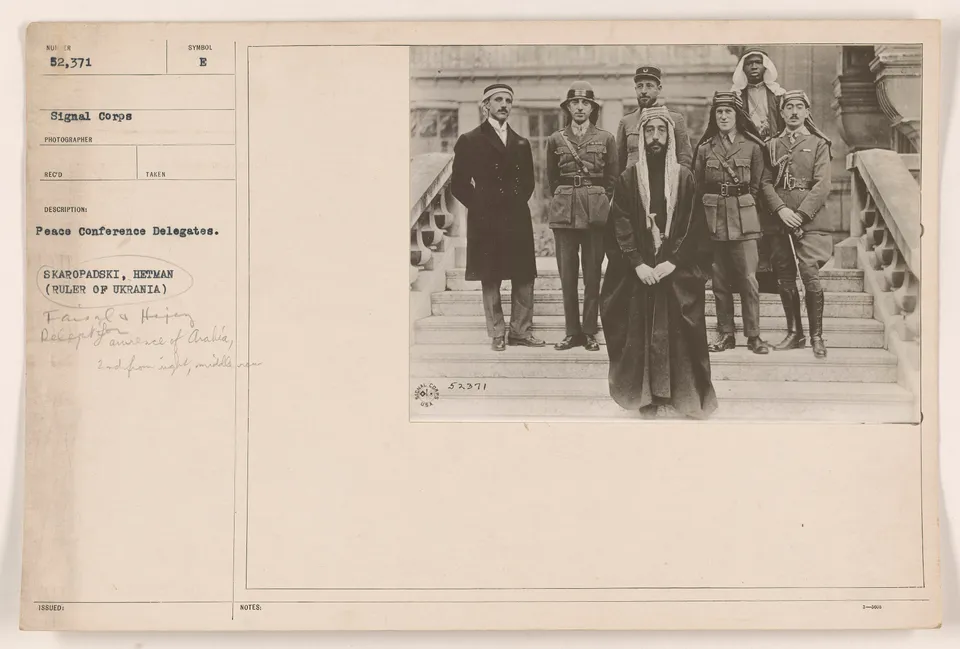
Faisal (front centre) and his party at the Paris Peace Conference, T. E. Lawrence among them, 1919

Public domain · Source

In June 1916 Hussein proclaimed the revolt in Mecca and styled himself King of the Arabs (the Allies recognized him as King of the Hejaz). Arab tribal forces under his son Faisal, funded and armed by Britain, cut the Hejaz Railway and tied down Ottoman troops, with the British officer T. E. Lawrence acting as liaison. They took the Red Sea port of Aqaba in July 1917 and, moving north alongside the British advance through Palestine, entered Damascus in October 1918.

After the war Faisal set up a Syrian kingdom in Damascus, but French troops drove him out, and the dream of a united, independent Arab state was dashed by the mandates.

The map in 1916

OpenFreeMap © OpenMapTiles © OpenStreetMap contributors

States at the time
Kingdom of Hejaz · established
Ottoman Empire · belligerent
Great Britain · sponsor
Places
Mecca, Damascus

People

  • Hussein bin Ali1854 – 1931

    leader · Sharif of Mecca who, after his correspondence with Britain, launched the Arab Revolt in 1916 and became King of the Hejaz

  • Faisal I of Iraq1885 – 1933

    commander · Son of Hussein bin Ali and a commander of the Arab Revolt, briefly King of Syria (1920) and then King of Iraq (1921–1933)

  • T. E. Lawrence1888 – 1935

    participant · British archaeologist and intelligence officer who served as liaison to the Arab Revolt and became known as "Lawrence of Arabia"

Before and after

Earlier
1915 Armenian Genocide

Related works

Dramatized works (films, dramas, novels) may differ from the historical record.

Themes that include this event

  • National Movements in Asia and Africa1915 – 1948

    From the Hussein–McMahon correspondence to the founding of Israel — three decades in which India, West Asia, Southeast Asia and Africa, swept up in the tide of self-determination after the First World War, pressed toward independence and modernization