The Birth and Coming of Dionysus
Also called: Dionysus, Bacchus, Semele
A legend handed down over the centuries.
A Greek myth told in Hesiod’s Theogony, the Homeric Hymns and Euripides’ tragedy The Bacchae. Dionysus, son of Zeus and the mortal Semele, was born from Zeus’ thigh after his mother was burned to death, and wandered the world teaching the making of wine until he was accepted as a god.
This Greek myth is mentioned briefly in Hesiod’s Theogony and told in the Homeric Hymns, Euripides’ Bacchae (first staged in 405 BC) and Book 3 of Ovid’s Metamorphoses. When Semele, a princess of Thebes, was carrying Zeus’ child, the jealous Hera came disguised as her nurse and urged her to ask her lover to prove he was Zeus by appearing in his true form. When Zeus revealed himself with his thunderbolt, Semele was burned to death; Zeus took the unborn child and sewed it into his thigh, giving birth to him when his time came. Dionysus is therefore called the “twice-born” god.
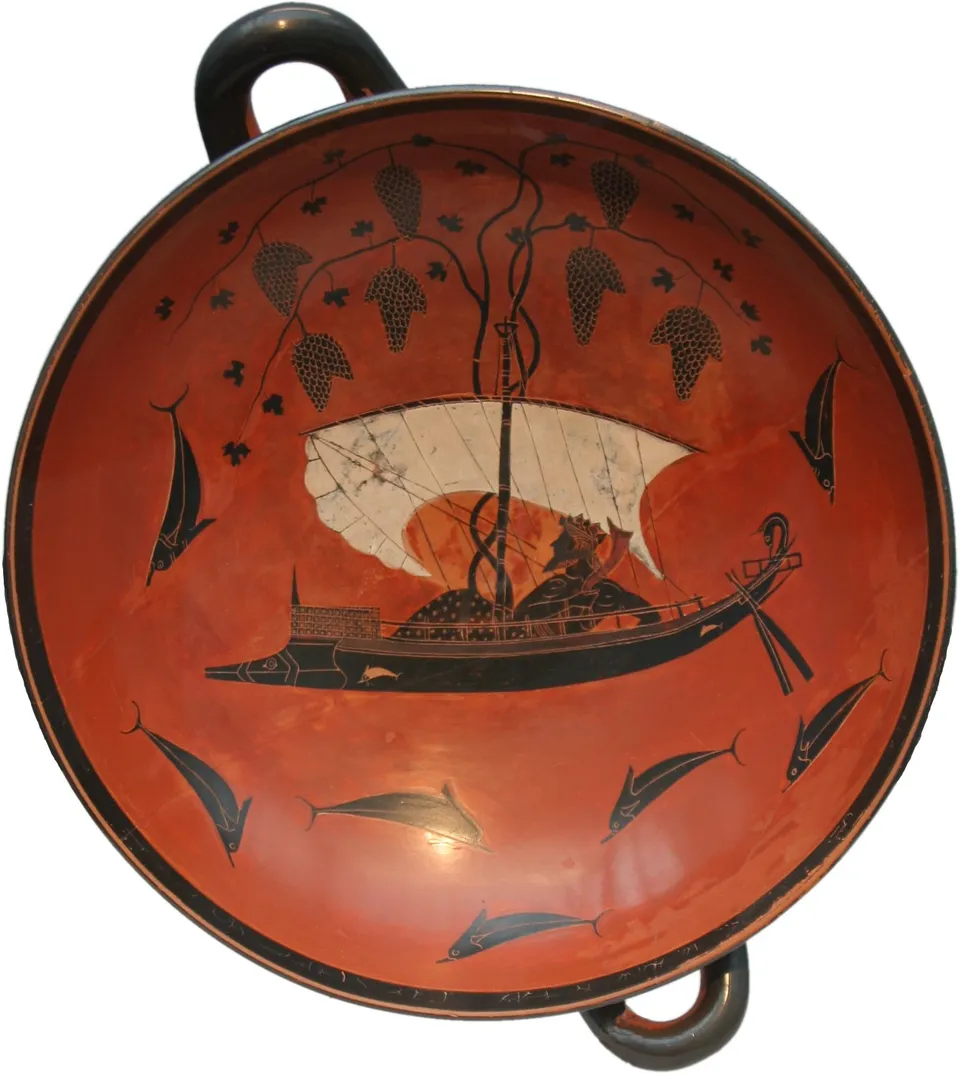
Raised by nymphs, Dionysus wandered as far as the East teaching the cultivation of the vine and wine, and returned to Greece with his female followers, the maenads. In The Bacchae Pentheus, king of Thebes, who refuses to recognise him as a god, is torn apart by his own frenzied mother and the women of Thebes. Homeric Hymn 7 tells how pirates who seized him were turned into dolphins. Dionysus was sometimes thought to be a latecomer among the gods, but his name (di-wo-nu-so) already appears on Mycenaean Linear B tablets. Tragedy and comedy were born at the Athenian festivals of Dionysus, and at Delphi he was said to be worshipped during the three winter months when Apollo was away.