Boxer Rebellion and Boxer Protocol
Also called: Yihetuan Movement, Boxer Uprising, Boxer Protocol
Under the slogan "Support the Qing, destroy the foreigners", the Boxers attacked churches and railways and besieged the foreign legations in Beijing. An eight-nation alliance occupied Beijing, and by the Boxer Protocol China paid a vast indemnity and accepted foreign troops on its soil.
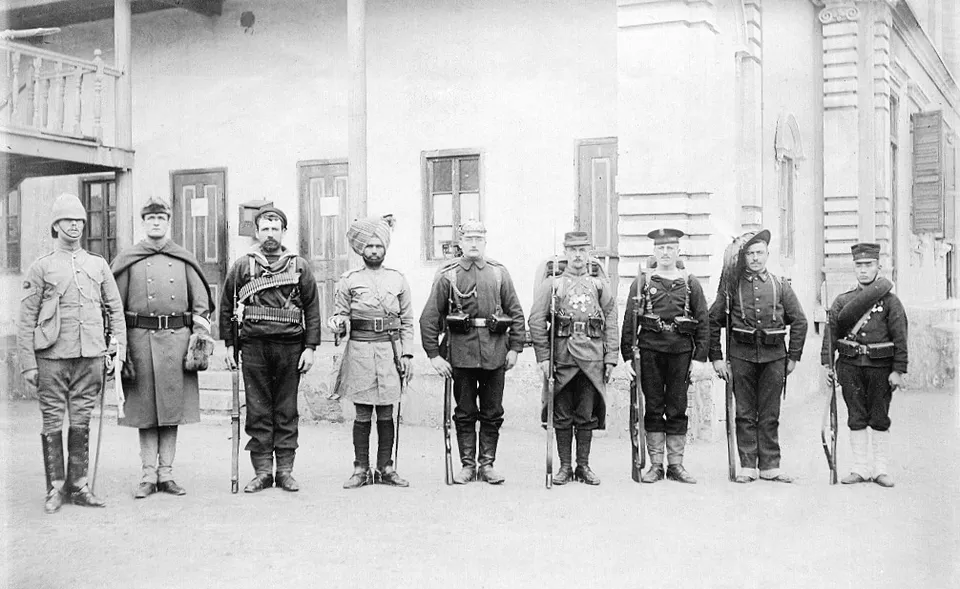
Probably German officer Franz Scholz (in Tientsin / Tianjin) · Public domain · Source
Resentment of the powers’ concessions and of the privileges of missionaries and Chinese Christians gave rise in Shandong to the Boxers, a martial-arts society that rose under the slogan "Support the Qing, destroy the foreigners". In June 1900 they entered Beijing, wrecked churches, railways and telegraphs, killed foreigners and Chinese Christians and besieged the legation quarter. Empress Dowager Cixi, hoping to use them, declared war on the powers.
An eight-nation force — Japan, Russia, Britain, France, the United States, Germany, Italy and Austria-Hungary — took Beijing on 14 August, and Cixi and the Guangxu Emperor fled to Xi’an. Japan sent the largest contingent. By the Boxer Protocol, signed by Li Hongzhang on 7 September 1901, China was to pay 450 million taels over 39 years and accepted foreign troops in the Beijing legation quarter and along the Beijing–Tianjin railway.
China sank deeper into semi-colonial status and belatedly launched the New Policies, preparing for a constitution. When Russia, having occupied Manchuria, refused to leave, Britain and Japan concluded the Anglo-Japanese Alliance in 1902 — the road to the Russo-Japanese War and the fate of the Korean Empire.