Land Reform in China
Also called: Agrarian Reform Law, Chinese Land Reform Movement, struggle session
The Agrarian Reform Law of June 1950 launched a nationwide redistribution of landlords’ land to peasants that lasted until 1952–1953. At village “struggle sessions” many landlords were publicly tried and executed.
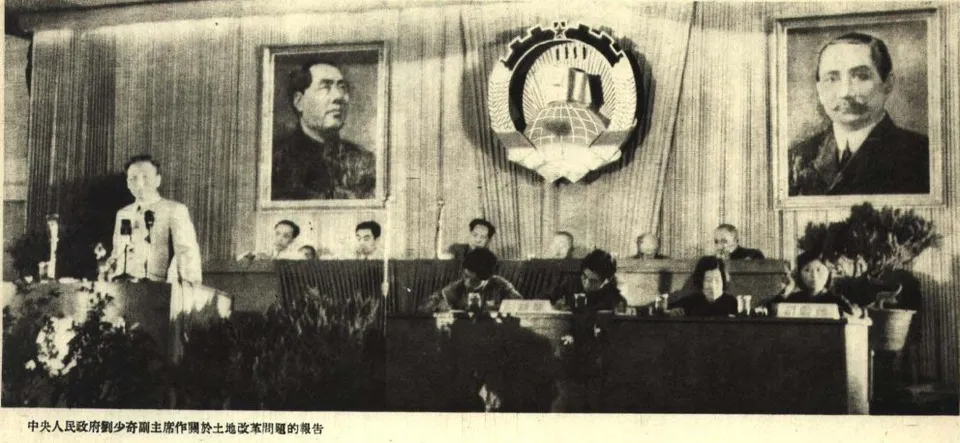
《人民画报》 · Public domain · Source
The Communists had carried out land reform in areas they held during the civil war, and on 28 June 1950 the new state promulgated the Agrarian Reform Law, extending it to the countryside of the East, Central-South and Southwest that had not yet been reformed. Work teams entered villages, sorted the population into landlords, rich peasants, middle peasants, poor peasants and labourers, and confiscated landlords’ land, livestock, tools and houses for distribution to the land-poor. Official figures say some 300 million peasants received land.
The reform was driven by village “struggle sessions” at which those classed as landlords were publicly denounced, beaten or executed. Overlapping with the contemporaneous campaign to suppress counter-revolutionaries, it cost many lives; estimates of the dead vary widely among scholars, from several hundred thousand to around two million or more.
The redistributed plots did not last. From 1953 mutual-aid teams and elementary co-operatives, then the advanced co-operatives of 1955–1956, collectivised agriculture rapidly, and in 1958 everything was merged into people’s communes.