Conflict25 June 1950 – 27 July 1953

Korean War

Also called: 6·25 War

A war that began with the North Korean invasion of the South at dawn on 25 June 1950. UN and Chinese forces joined, and the armistice of 27 July 1953 drew the present demarcation line.
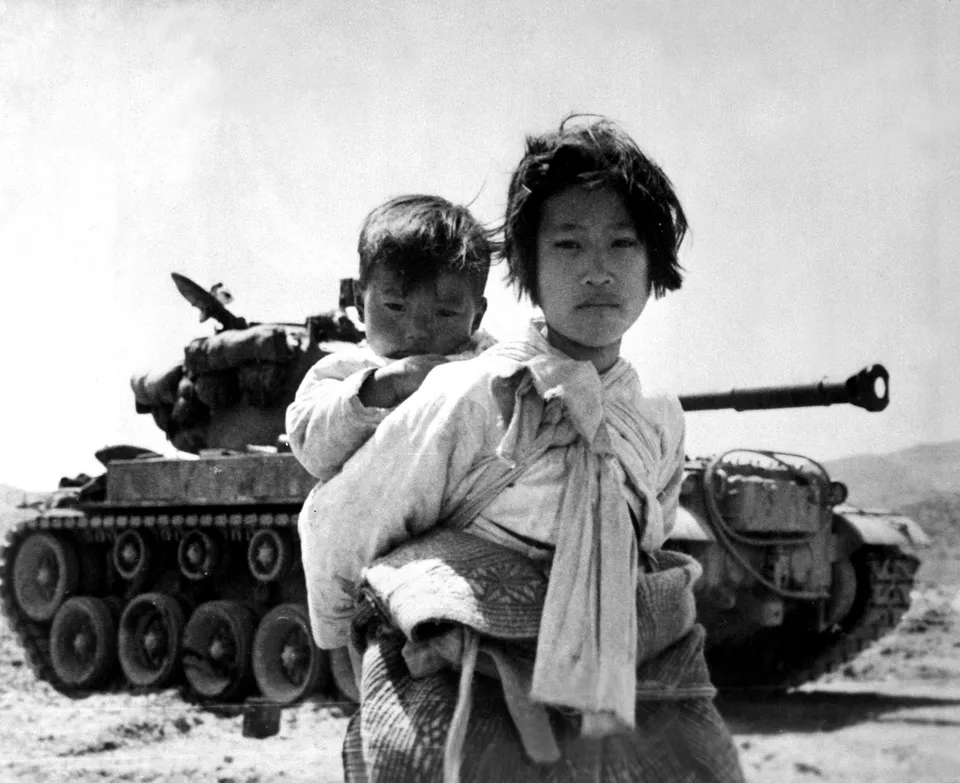
A girl carrying her brother on her back trudges past a stalled tank at Haengju, 9 June 1951

Maj. R.V. Spencer, UAF (Navy). U.S. Army Korea - Installation Management Command. · Public domain · Source

With rival governments in place in a Cold War world, the United States left Korea outside its Pacific defence perimeter in the Acheson Declaration of January 1950. Promised Soviet and Chinese support, North Korea invaded on 25 June, took Seoul in three days and drove the South Korean army back to the Nakdong River. The UN Security Council condemned the aggression and sent UN forces, with combat troops from sixteen countries.

The Incheon landing in September turned the tide, leading to the recapture of Seoul and an advance north, but Chinese intervention in October pushed the UN forces back into the January Fourth Retreat. From spring 1951 the front settled near the 38th parallel and armistice talks began in July; after two more years of fighting over hilltops the armistice was signed on 27 July 1953.

The war killed and wounded vast numbers, separated families and orphaned children, and laid waste to land and industry. South Korea concluded a mutual defence treaty with the United States, and both Koreas used anti-communism or anti-Americanism to entrench dictatorial rule.

The map in 1950

OpenFreeMap © OpenMapTiles © OpenStreetMap contributors

States and rulers at the time
South Korea · belligerent — President Syngman Rhee
North Korea · belligerent — Supreme Leader Kim Il Sung
United States · UN forces — President Harry S. Truman
People's Republic of China · intervened — Paramount leader Mao Zedong

6 parts of this event

  1. 1

    North Korean forces attacked across the whole 38th parallel, took Seoul in three days and drove south to the Nakdong River.

  2. 2

    UN forces under MacArthur landed at Incheon, cut North Korean supply lines and turned the course of the war.

  3. 3

    South Korean and UN forces retook Seoul, crossed the 38th parallel, took Pyongyang and pushed on to the Yalu River.

  4. 4

    Chinese forces crossed the Yalu and entered the war, driving South Korean and UN forces south again; the eastern front withdrew by sea from Hungnam.

  5. 5

    A Chinese offensive forced South Korean and UN forces to abandon Seoul again. After Seoul was retaken in March 1951 the front stabilized near the 38th parallel.

  6. 6

    After more than two years of talks, the armistice was signed at Panmunjom, fixing the Military Demarcation Line and the Demilitarized Zone.

Before and after

Related works

Dramatized works (films, dramas, novels) may differ from the historical record.

Themes that include this event

  • The Cold War1945 – 1991

    From Yalta to the dissolution of the Soviet Union — half a century in which two blocs led by the US and the USSR divided the world