Chinese Civil War
Also called: Chinese Communist Revolution, Liberation War, Huaihai Campaign
After Japan’s surrender, full-scale civil war between the Nationalists and the Communists resumed in 1946. Having won over the peasants through land reform, the Communists triumphed in three great campaigns in 1948–1949, and the Nationalist government moved to Taiwan.
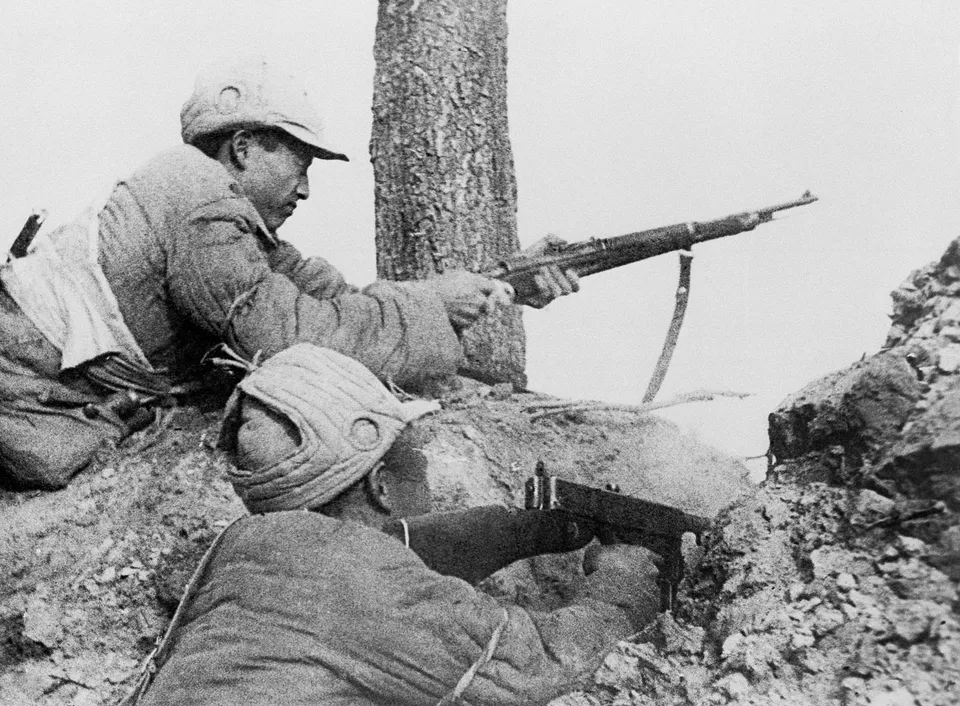
Unknown author · Public domain · Source
When Japan surrendered in August 1945, Mao Zedong met Chiang Kai-shek in Chongqing and in October they signed the Double Tenth Agreement, while the American general George Marshall also attempted mediation. But the two sides kept fighting over Japanese weapons and territory in the Northeast (Manchuria) and north China, and when Nationalist forces attacked Communist areas in June 1946 full-scale war began.
At first the Nationalists, ahead in US aid and manpower, prevailed and even took Yan’an in 1947. But the Communists won peasant support by redistributing landlords’ land in the areas they held, while corruption and runaway inflation drove people away from the Nationalists. Between September 1948 and January 1949 the People’s Liberation Army destroyed the Nationalist main forces in the three great campaigns of Liaoshen, Huaihai and Pingjin, and Beiping changed hands without a fight. In April 1949 it crossed the Yangtze and took Nanjing.
The People’s Republic of China was proclaimed on 1 October, and in December Chiang’s Republic of China government moved to Taipei. So began the cross-Strait relationship in which the People’s Republic on the mainland and the Republic of China on Taiwan each claimed to be the legitimate China.