Coronation of Charlemagne
Also called: Carolingian Renaissance
Charles, the Frankish king who had united most of Western Europe, was crowned Emperor of the Romans by Pope Leo III in Rome on Christmas Day 800.
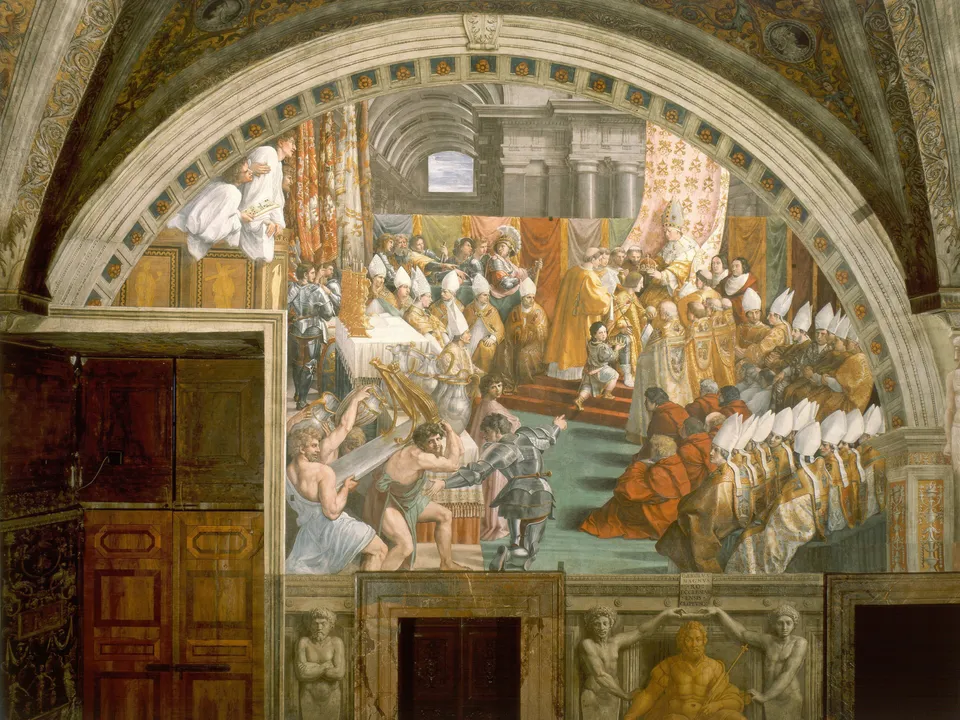
Raphael · Public domain · Source
Becoming king of the Franks in 768, Charles conquered the Lombard kingdom of northern Italy (774), the Saxons and the Avars, and pushed into north-eastern Spain, uniting most of Western Europe across today’s France, Germany and northern Italy. He governed his wide lands through counts in each region, supervised by travelling royal envoys (missi dominici).
On 25 December 800, in St Peter’s in Rome, Pope Leo III crowned Charles “Emperor of the Romans”. The title of western emperor, lapsed since 476, was revived, and a Western European world blending Roman culture, Christianity and Germanic tradition took shape as a world distinct from Byzantium. The pope gained a protector in the West, independent of the Byzantine emperor.
Charlemagne invited scholars such as Alcuin of York to his court at Aachen, founded schools and had classical texts copied, reviving Latin learning (the Carolingian Renaissance). The Carolingian minuscule developed at this time is the basis of today’s lower-case Roman letters. At this time Silla was in its late period, torn by aristocratic struggles over the throne, and Balhae would soon, under King Seon, be called the “Flourishing Land in the East”.