ConflictOctober 1853 – 30 March 1856

Crimean War

Also called: Siege of Sevastopol, Treaty of Paris (1856)

When Russia, seeking to expand southward, went to war with the Ottoman Empire, Britain, France and Sardinia sided with the Ottomans. Russia lost Sevastopol and the war, and its southward drive was checked.
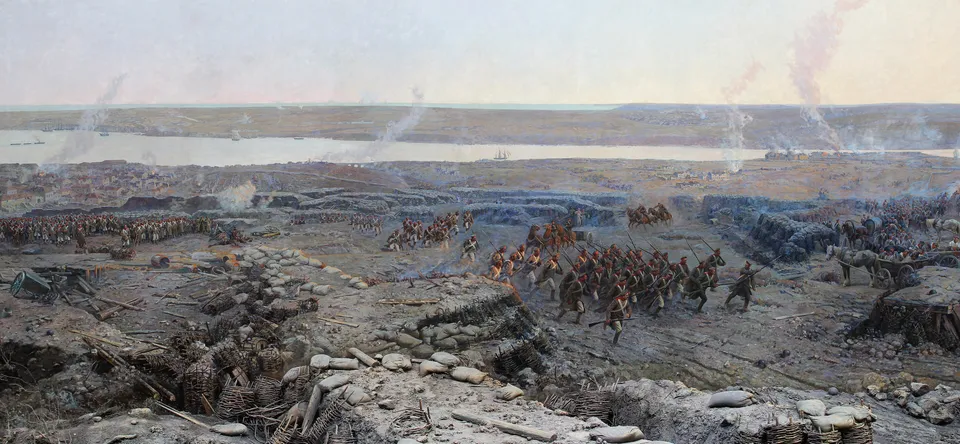
Detail of Franz Roubaud’s panorama of the Siege of Sevastopol (1904) — Sevastopol Panorama Museum

photo by George Chernilevsky · CC BY 4.0 · Source

Russia pressed the weakening Ottoman Empire to win an outlet to the Mediterranean (its southward policy). Citing the custody of the holy places in Jerusalem and the protection of Orthodox Christians in the empire, Russia occupied the Danubian principalities in 1853, and the Ottomans declared war. Fearing Russian control of the Black Sea, Britain and France joined in 1854, and Sardinia sent troops in 1855. The allies besieged the Crimean naval base of Sevastopol for nearly a year before taking it in September 1855.

The Treaty of Paris (1856) neutralized the Black Sea. Far more soldiers died of disease than in battle, and Florence Nightingale reformed sanitation in the military hospitals. It was also a modern war, reported almost as it happened by telegraph, war correspondents and photographers. Defeat showed Russia how backward it was and led to reforms such as the emancipation of the serfs; Russia also turned east, gaining the Maritime Province by the Treaty of Beijing in 1860 and so coming to border Joseon Korea.

The map in 1853

OpenFreeMap © OpenMapTiles © OpenStreetMap contributors

States at the time
Russia · defeated
Ottoman Empire · victor
Great Britain · intervened
France · intervened
Kingdom of Sardinia · intervened

People

  • Alexander II of Russia1818 – 1881

    monarch · Emperor of Russia (1855–1881) who, after defeat in the Crimean War, emancipated the serfs and pursued reform from above, but was assassinated by revolutionaries

  • Napoleon III1808 – 1873

    monarch · Louis-Napoléon, nephew of Napoleon I, elected president in 1848, who made himself emperor (1852–1870) by a coup but was captured in the Franco-Prussian War and deposed

  • Florence Nightingale1820 – 1910

    participant · British nurse who reformed sanitation in the military hospitals of the Crimean War, cutting soldiers’ death rates, and laid the foundations of modern nursing and its training

Before and after

Themes that include this event

  • Revolutions and Nation-States1776 – 1871

    From the Declaration of Independence to the German Empire — a century in which liberalism and nationalism toppled the old order in Europe and the Americas and built nation-states