East–West Schism
Also called: Great Schism, Schism of 1054
In 1054 the papal legate and the patriarch of Constantinople excommunicated each other, splitting Christianity into Roman Catholicism in the west and Greek Orthodoxy in the east.
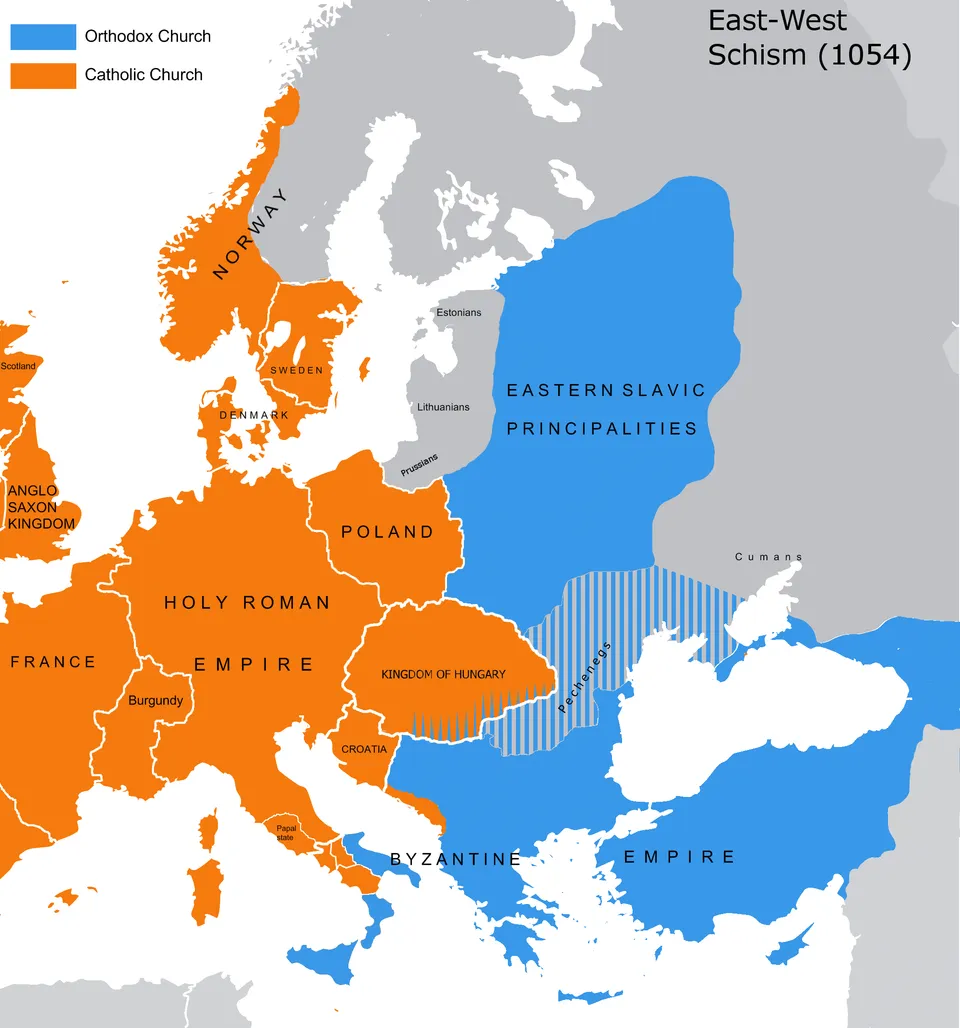
Tobi85 · Public domain · Source
After the fall of the Western Roman Empire the churches of Rome and Constantinople drifted apart, diverging in language (Latin and Greek) and ritual. Friction over iconoclasm, the crowning of a separate emperor in the West with Charlemagne, the addition of “and the Son” (filioque) to the Creed, and the pope’s claim to stand above all churches all clashed.
In July 1054 Cardinal Humbert, the pope’s legate, laid a bull excommunicating Patriarch Michael Cerularius on the altar of Hagia Sophia, and the patriarch in turn excommunicated the legates. From then on the west followed Roman Catholicism centred on the pope, and the east Greek Orthodoxy under the protection of the Byzantine emperor. In the Orthodox world the emperor tended also to act as head of the Church (caesaropapism).
The rift deepened when the Fourth Crusade sacked Constantinople in 1204. The mutual excommunications were lifted only in 1965. At this time Goryeo was in the reign of King Munjong, when private academies such as Choe Chung’s Nine Course Academy arose and culture flourished.