The Exodus
Also called: Exodus from Egypt, Crossing of the Red Sea, Ten Commandments
A story told in religious scripture.
A story told in the Book of Exodus in the Hebrew Bible: the Israelites, enslaved in Egypt, followed Moses through ten plagues and a parted sea out of Egypt, and received the Ten Commandments on Mount Sinai.
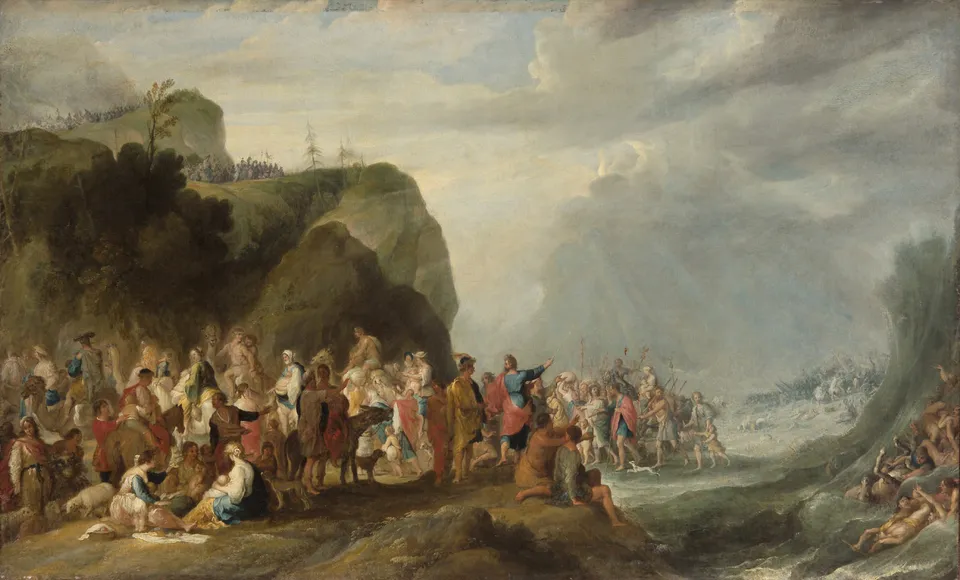
Cornelis de Wael · Public domain · Source
This is the story told in the Book of Exodus. When Pharaoh set the Israelites to slave labour building the cities of Pithom and Rameses, God (Yahweh) called Moses to lead them out. As Pharaoh refused again and again, ten plagues fell on Egypt, from the Nile turning to blood to the death of the firstborn; the Israelites escaped the last by marking their doorposts with a lamb’s blood (the origin of Passover). Before the pursuing Egyptian army the sea parted to make a path, closing again once the Israelites had crossed.
In the wilderness they made a covenant with God at Mount Sinai and received the Ten Commandments, then wandered for forty years before reaching Canaan. The Exodus became the central memory of Judaism and is still celebrated at Passover.
The story is not confirmed by Egyptian records or archaeology. Biblical chronology points to the 15th century BCE, while the place names Pithom and Rameses suggest the 13th century under Ramesses II. The name “Israel” first appears around 1208 BCE on the Merneptah Stele of Egypt, as a people in Canaan. Many scholars read the Exodus as Israel’s founding story, perhaps preserving the memory of a smaller group.