Politics30 December 1922

Founding of the Soviet Union

Also called: USSR, Union of Soviet Socialist Republics

Four Soviet republics — Russia, Ukraine, Belarus and Transcaucasia — joined to form the Union of Soviet Socialist Republics, the world’s first socialist federal state.
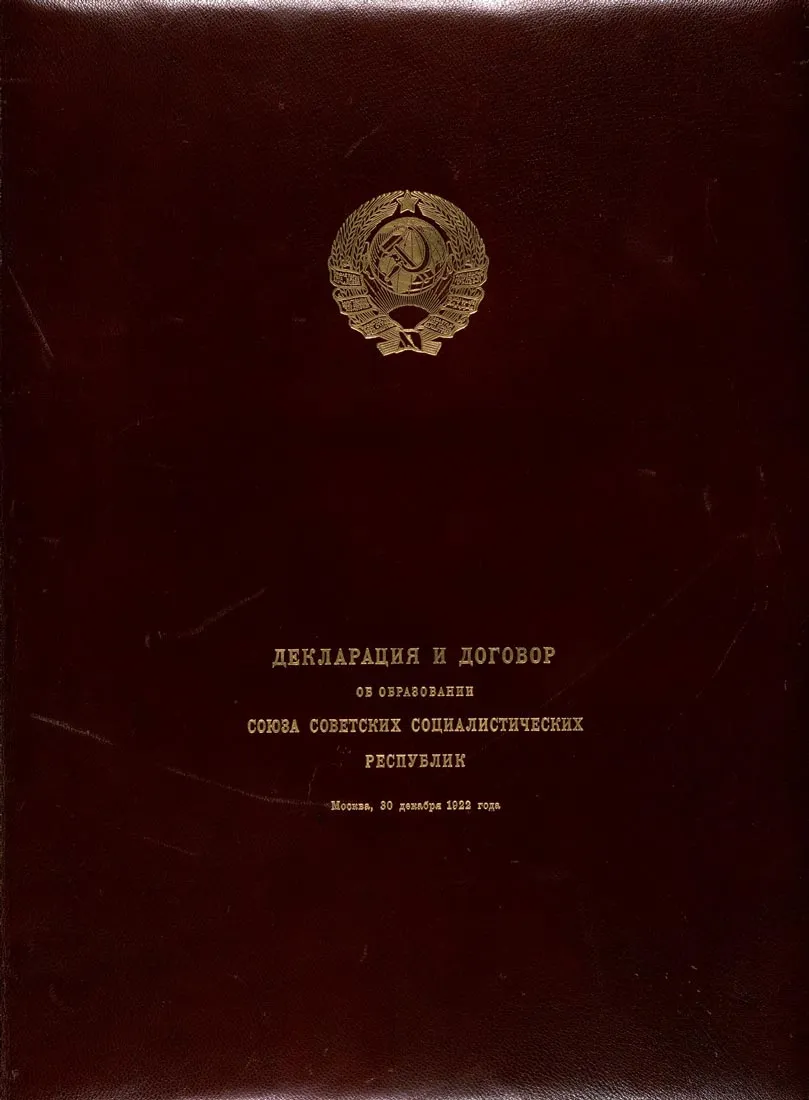
Cover of the 1922 Declaration and Treaty on the Formation of the USSR

State Register of Unique Documents of the Archival Fund of the Russian Federation · Public domain · Source

Victorious in the Civil War, the Bolsheviks sought to unite the Soviet republics set up across the former Russian Empire. Lenin opposed Stalin’s plan to absorb them into Russia and called instead for a federation of equal republics.

On 30 December 1922 the First Congress of Soviets in Moscow approved the treaty of union between the Russian, Ukrainian, Byelorussian and Transcaucasian republics, founding the Union of Soviet Socialist Republics. The 1924 constitution even gave the republics the right to secede, but real power lay with the Communist Party in Moscow.

Disabled by strokes, Lenin died in January 1924. In notes treated as his testament he warned against the general secretary Stalin, yet Stalin won the power struggle with Trotsky and others and built a dictatorship. The Soviet Union led the socialist camp until its dissolution in 1991.

The map in 1922

OpenFreeMap © OpenMapTiles © OpenStreetMap contributors

States and rulers at the time
Soviet Union · established — Leader Vladimir Lenin
Russia
Places
Moscow Kremlin

People

  • Vladimir Lenin1870 – 1924

    leader · Leader of the Bolsheviks who set up the Soviet government in the October Revolution of 1917, chaired it, and founded the USSR in 1922

  • Joseph Stalin1878 – 1953

    participant · General Secretary of the Soviet Communist Party who ruled the USSR from the late 1920s until his death, led the war against Germany and drew Eastern Europe into the Soviet bloc

  • Leon Trotsky1879 – 1940

    related figure · Bolshevik leader who directed the armed rising of the October Revolution, negotiated with Germany as foreign commissar, and built the Red Army that won the Civil War

Before and after

Earlier
1921 Free City Incident

Themes that include this event

  • World War I and the Russian Revolution1908 – 1923

    From the Balkan crises to a war of trenches and total mobilization that toppled four empires; the Russian Revolution it unleashed, which created the first socialist state; and the Versailles settlement of national self-determination and the League of Nations