World history1908 – 192327 events

World War I and the Russian Revolution

From the Balkan crises to a war of trenches and total mobilization that toppled four empires; the Russian Revolution it unleashed, which created the first socialist state; and the Versailles settlement of national self-determination and the League of Nations

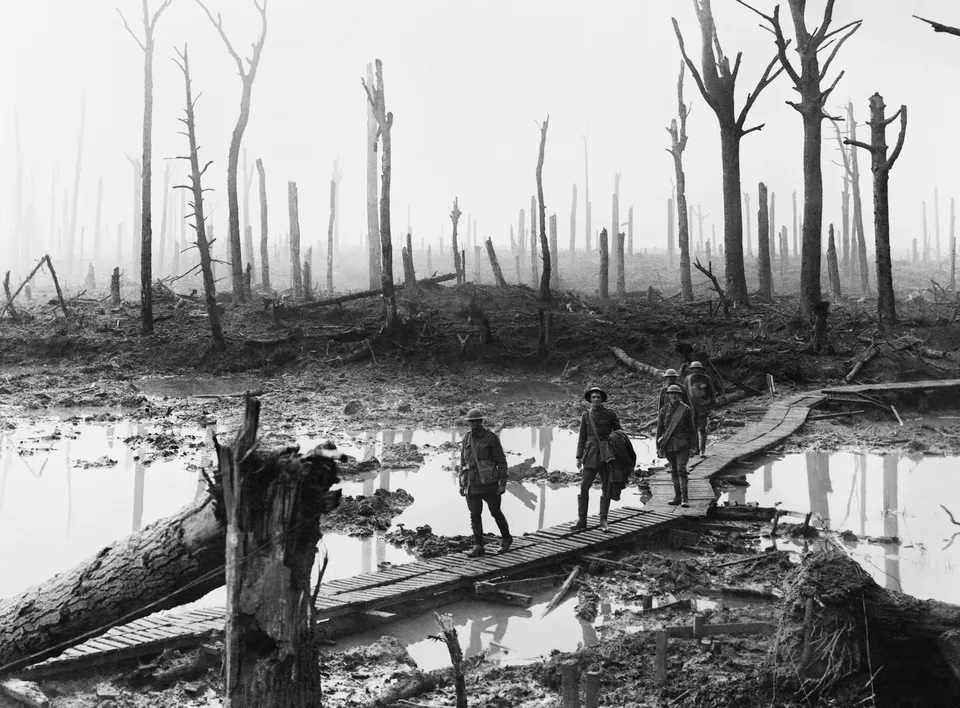
포격으로 숲이 사라진 벨기에 이프르 근처 샤토 숲의 오스트레일리아 병사들 — 1917년 10월

Frank Hurley · Public domain · Source

At a glance

EventWhat happenedResult · significance
Annexation of Bosnia (1908)Austria annexes Bosnia-HerzegovinaPan-German vs Pan-Slav; “powder keg”
Balkan Wars (1912–1913)Balkan League beats Ottomans, then BulgariaSerbia grows; Bulgaria joins Central Powers
Sarajevo (1914)Serb youth kills Austrian heirTriple Alliance vs Entente at war
Marne (1914)Schlieffen Plan failsTrench warfare, long war
Verdun · Somme (1916)Attrition; first tanksTotal war: guns, gas, tanks, aircraft
US enters (1917)U-boat war, Zimmermann TelegramAllies gain upper hand; US rises
February Revolution (Mar 1917)Petrograd rising; Nicholas II abdicatesDual power: government and Soviet
October Revolution (Nov 1917)Lenin’s Bolsheviks seize powerPeace and Land decrees; first socialist state
Brest-Litovsk (1918)Russia’s separate peaceRussia quits war, loses vast lands
Civil War · War CommunismReds vs Whites; grain requisitioningRed victory; economic collapse, famine
Fourteen Points (Jan 1918)Wilson: self-determination, a LeagueInspires colonial movements (March First)
German Revolution (Nov 1918)Kiel mutiny; Kaiser abdicatesRepublic → Weimar Constitution (1919)
Treaty of Versailles (1919)War guilt, reparations, colonies lost, arms cutGerman resentment; Versailles system
Saint-Germain · TrianonAustria-Hungary dissolvedNew states; minority problems
League of Nations (1920)First peace organization, GenevaNo US; no military sanctions
New Economic Policy (1921)Requisitioning ends; small private tradeRecovery → USSR founded (1922)

The theme on the map

OpenFreeMap © OpenMapTiles © OpenStreetMap contributors

27 events in this theme

  1. When Austria-Hungary formally annexed Bosnia and Herzegovina, which it had been administering, Serbia and Russia protested fiercely. Germany backed Austria and Russia gave way.

  2. 1912 – 1913Balkan Wars

    The Balkan League (Serbia, Bulgaria, Greece and Montenegro) attacked the Ottoman Empire and took almost all its European lands; then Bulgaria and its former allies fought over the spoils.

  3. Gavrilo Princip, a young Bosnian Serb, shot dead the Austrian heir and his wife on their visit to Sarajevo. The killing set off the First World War.

  4. 1914 – 1918World War I

    Triggered by the assassination in Sarajevo, the European powers fought in two blocs. Four empires collapsed.

  5. French and British troops stopped the German army, which had swept through Belgium almost to Paris, on the river Marne. Germany’s plan for a short war collapsed and the Western Front froze into trench warfare.

  6. 1915 – 1916Armenian Genocide

    During the war the Ottoman government deported the Armenians to the Syrian desert; through massacres and death marches several hundred thousand to over a million people died.

  7. 1915 – 1916Gallipoli Campaign

    British, French, Australian and New Zealand troops landed on the Gallipoli peninsula to force the Dardanelles and strike at Istanbul, but were held by the Ottoman army and withdrew after eight months.

  8. The German army attacked the fortress zone of Verdun for nearly ten months to bleed the French army dry, but the French under Pétain held. Casualties on both sides reached some 700,000.

  9. The largest naval battle of the First World War, fought between the British Grand Fleet and the German High Seas Fleet in the North Sea off Denmark’s Jutland peninsula. Britain lost more, but kept command of the sea.

  10. A great British and French offensive to break the German trench line along the river Somme. British casualties on the first day alone neared 60,000, and tanks were used for the first time. In four and a half months the Allies advanced little more than 10 kilometres.

  11. The tsarist monarchy fell and the Bolsheviks seized power. The Soviet Union was founded in 1922.

  12. When Germany declared that its submarines would sink without warning any ship in the waters around Britain, the neutral United States declared war on Germany — a turning point that secured the Allied victory.

  13. Exhausted by war and hunger, the workers and soldiers of Petrograd rose up; Nicholas II abdicated and the Romanov dynasty came to an end. Power was split between the Provisional Government and the Soviet.

  14. The Bolsheviks led by Lenin overthrew the Provisional Government in an armed rising and set up a Soviet government — the world’s first socialist regime.

  15. In a speech to Congress, President Wilson set out fourteen principles for the post-war peace — an end to secret diplomacy, national self-determination, a League of Nations — raising great hopes among colonial peoples.

  16. Soviet Russia made a separate peace with Germany and the other Central Powers and left the war, giving up vast lands including Poland, the Baltic region and Ukraine.

  17. The Bolsheviks’ Red Army fought and defeated the counter-revolutionary Whites and foreign interventionist forces, while the government imposed War Communism — forced grain requisitioning and the nationalization of industry.

  18. 1918 – 1919German Revolution

    A mutiny of sailors at the naval port of Kiel spread across the country; Wilhelm II abdicated and Germany became a republic, with the Social Democrat Ebert at the head of a provisional government.

  19. Germany signed an armistice with the Allies in a railway carriage in the forest of Compiègne. At 11 a.m. on 11 November the guns fell silent and the First World War, more than four years long, came to an end.

  20. Delegates of the victorious powers met in Paris to draw up the peace treaties with the defeated states. Led by Wilson, Clemenceau and Lloyd George, the conference created the Versailles settlement.

  21. Germany’s National Assembly met at Weimar, elected Ebert president and drew up the Weimar Constitution — a democratic charter with universal suffrage for men and women and social rights.

  22. Beginning on 1 March 1919 with the reading of a declaration of independence, demonstrations spread across the country. It led to the founding of the Provisional Government of the Republic of Korea.

  23. The peace treaty between the Allies and Germany signed in the Hall of Mirrors at Versailles. Germany accepted responsibility for the war, lost territory and colonies, had its armed forces restricted and was saddled with huge reparations.

  24. The peace treaties the Allies made with Austria (Saint-Germain), Bulgaria (Neuilly) and Hungary (Trianon). The Austro-Hungarian Empire was dissolved and new states arose in Central Europe.

  25. Proposed by Wilson, the first international organization to keep world peace was set up in Geneva, Switzerland. But the United States stayed out and the League had no military means of enforcement, so it failed to stop aggression.

  26. With the economy shattered by civil war and peasants in revolt, Lenin ended grain requisitioning and allowed small-scale private trade and enterprise. The economy gradually recovered to pre-war levels.

  27. Four Soviet republics — Russia, Ukraine, Belarus and Transcaucasia — joined to form the Union of Soviet Socialist Republics, the world’s first socialist federal state.

Key people

  • Vladimir Lenin1870 – 1924

    Leader of the Bolsheviks who set up the Soviet government in the October Revolution of 1917, chaired it, and founded the USSR in 1922

  • Woodrow Wilson1856 – 1924

    28th US president (1913–1921) who took America into the war in 1917 and proclaimed national self-determination and a League of Nations in his Fourteen Points; Nobel Peace Prize 1919

  • Leon Trotsky1879 – 1940

    Bolshevik leader who directed the armed rising of the October Revolution, negotiated with Germany as foreign commissar, and built the Red Army that won the Civil War

  • Wilhelm II1859 – 1941

    Last German emperor (1888–1918), whose Weltpolitik and naval build-up set Germany against Britain; he abdicated in the German Revolution of 1918 and went into exile in the Netherlands

  • Ferdinand Foch1851 – 1929

    French general who became Allied supreme commander in 1918, halted Germany’s last offensive, led the counter-attack and received the armistice at Compiègne

  • Alexander Kerensky1881 – 1970

    Minister of justice and war and then prime minister (1917) of the Provisional Government after the February Revolution; he kept Russia in the war and was overthrown in October

  • Friedrich Ebert1871 – 1925

    Leader of the Social Democratic Party who took over as chancellor in the German Revolution of 1918 and became the first president of the Weimar Republic (1919–1925)

  • Georges Clemenceau1841 – 1929

    French prime minister (1906–1909, 1917–1920), nicknamed “the Tiger”, who led France through the last year of the war and, as president of the Paris Peace Conference, pressed for harsh terms on Germany

  • David Lloyd George1863 – 1945

    British prime minister (1916–1922) who introduced social insurance as chancellor, led the wartime coalition and represented Britain at the Paris Peace Conference

  • Gavrilo Princip1894 – 1918

    Bosnian Serb youth who shot the Austrian heir and his wife in Sarajevo in 1914

  • Franz Ferdinand1863 – 1914

    Heir to the throne of Austria-Hungary, assassinated with his wife in Sarajevo in 1914

  • Joseph Joffre1852 – 1931

    Commander-in-chief of the French army (1911–1916), hailed as “the victor of the Marne” for halting the German advance in 1914