Galileo’s Telescope and His Trial
Also called: Trial of Galileo, Sidereus Nuncius, Galileo affair
In 1610 Galileo used telescopes of his own making to observe the mountains of the Moon and the moons of Jupiter, supporting heliocentrism, but in 1633 the Roman Inquisition forced him to abjure it.
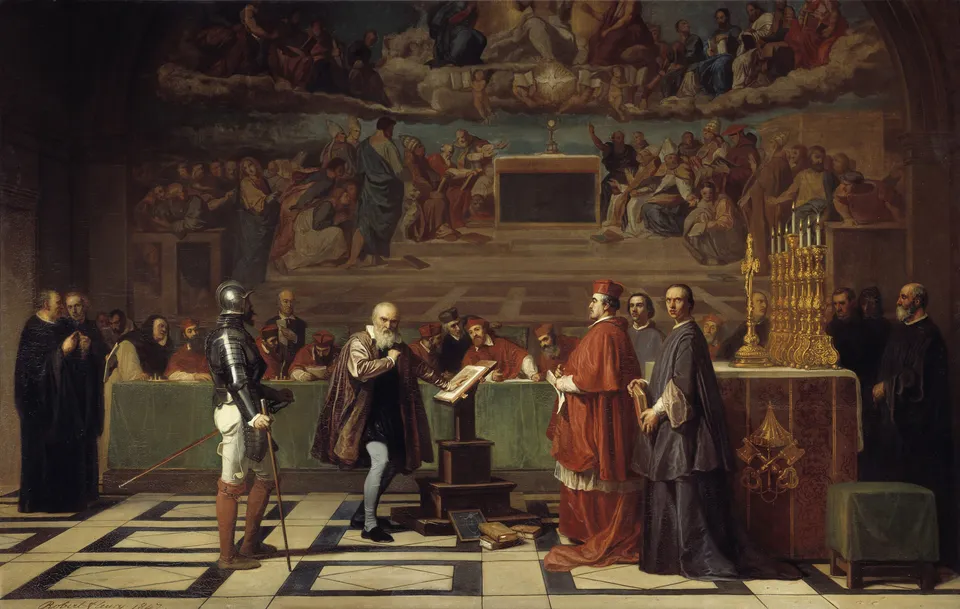
Joseph-Nicolas Robert-Fleury · Public domain · Source
Hearing in 1609 that the telescope had been invented in the Netherlands, Galileo, a professor at the University of Padua, built more powerful instruments himself. In The Starry Messenger (1610) he reported mountains and craters on the Moon, four moons circling Jupiter and the countless stars of the Milky Way, and he later observed the phases of Venus and sunspots. Such evidence contradicted the old cosmos in which the heavens were perfect and everything circled the Earth.
In 1616 the Church warned against teaching heliocentrism, but in his Dialogue Concerning the Two Chief World Systems (1632) Galileo in effect defended it. Summoned before the Roman Inquisition the next year, he abjured heliocentrism on 22 June and spent the rest of his life under house arrest at Arcetri near Florence. The story that he muttered “And yet it moves” is a later legend. Even under arrest he published Two New Sciences (1638), on the laws of falling bodies, in the Netherlands.
Galileo established the method of modern science — investigating nature through experiment, observation and mathematics. The Catholic Church acknowledged only in 1992 that the trial had been a mistake.