Mahayana Buddhism and Gandhara Art
Also called: Greco-Buddhist art, Mahayana
Mahayana Buddhism, promising salvation for all beings, arose, and under the Kushans the first images of the Buddha were carved in Gandhara under the influence of Greek sculpture.
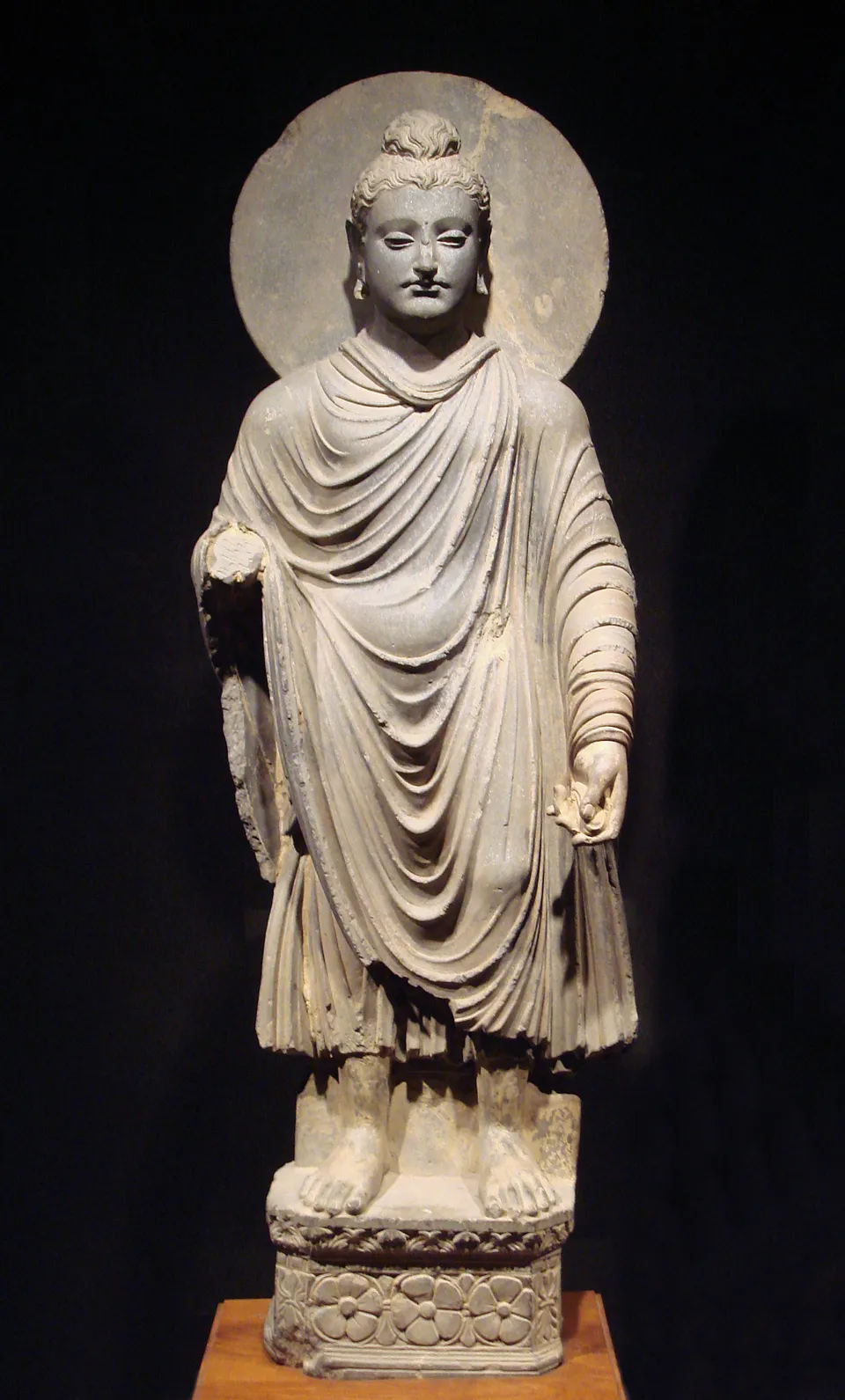
World Imaging · Public domain · Source
Around the turn of the era a new current arose in Indian Buddhism. Unlike the older tradition centred on the liberation of individual monks (Theravada — which Mahayana followers belittled as the "Lesser Vehicle"), Mahayana Buddhism sought the salvation of all beings by following the bodhisattvas, who seek enlightenment while helping others. Devotion to buddhas and bodhisattvas spread, and around the 2nd century Nagarjuna gave the movement its philosophy of emptiness (shunyata).
Earlier art had not shown the Buddha in human form, using symbols such as the Bodhi tree, the wheel of the law or footprints. From around the 1st century the first Buddha images were made in Gandhara (the Peshawar basin of today’s Pakistan) and at Mathura under the Kushans. Gandharan Buddhas, influenced by the Hellenistic sculpture that came in after Alexander’s campaign, have wavy hair, straight noses, deep-set eyes and naturalistic folds of drapery.
Mahayana Buddhism and Buddha images travelled the Silk Road through Central Asia and China (the caves of Dunhuang and Yungang) to Korea and Japan. The Buddhism that reached Korea was Mahayana, and the main Buddha of Seokguram in Gyeongju belongs to this lineage. Theravada Buddhism spread to Sri Lanka and Southeast Asia.