World history770 BC – AD 22026 events

Ancient China and India

From the Hundred Schools of the Warring States to the unified empires of Qin and Han, and from the Buddha to the Maurya and Kushan empires — the millennium that shaped East and South Asian civilisation
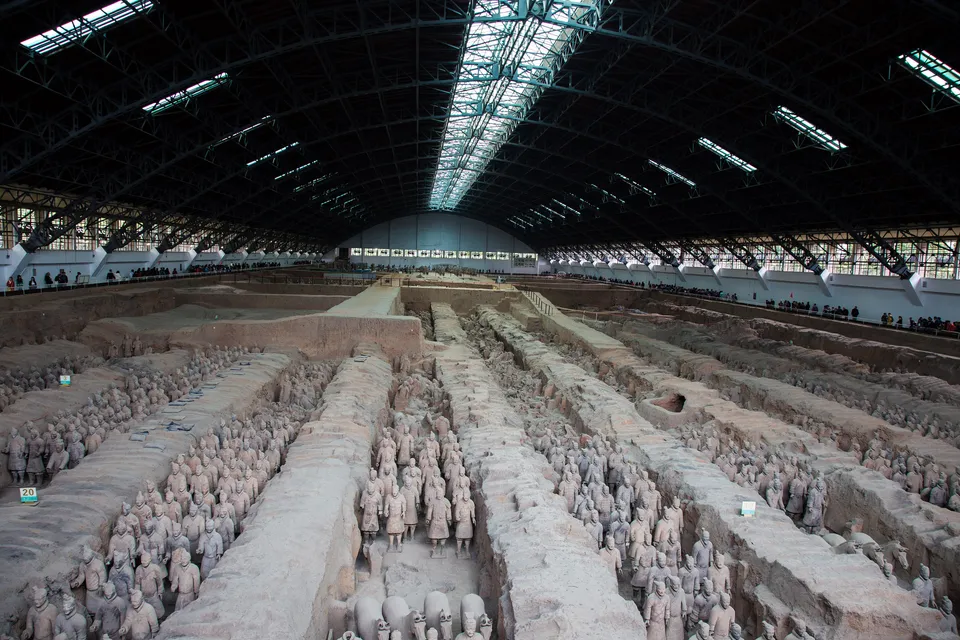
진시황릉의 병마용 1호 갱 — 중국 시안

Jmhullot · CC BY 3.0 · Source

At a glance

YearStateEventKey points
7th–5th c. BCESpring and Autumn statesFive HegemonsHonour the king; leagues; Duke Huan
6th c. BCELuConfuciusRen and li; rule by virtue; Analects
6th–5th c. BCEGanges valleyBuddhism and JainismAgainst caste; liberation; kshatriya support
6th–3rd c. BCEWarring StatesHundred SchoolsConfucian, Daoist, Mohist, Legalist
403 BCESeven PowersWarring StatesIron tools, ox ploughs, bronze coins
356 BCEQinShang Yang’s reformsLegalism; merit ranks; counties
c. 322 BCEMauryaChandragupta’s empireFirst pan-Indian empire; Pataliputra
3rd c. BCEMauryaAshokaKalinga; pillar edicts; Sanchi stupa
221 BCEQinUnificationCommanderies; script, coins, measures
202 BCEHanFounding of HanGaixia; kingdoms and commanderies
141–87 BCEHanEmperor WuConfucian state; salt-iron monopoly; Gojoseon
139 BCEHanZhang QianYuezhi; Silk Road
c. 91 BCEHanShijiAnnals-biography form; Joseon account
8XinWang MangLand nationalised; archaising reforms
105Later HanCai Lun’s paperFour Great Inventions
2nd c.KushanKanishkaMahayana; Gandhara art; Purushapura

The theme on the map

OpenFreeMap © OpenMapTiles © OpenStreetMap contributors

26 events in this theme

  1. After the Quanrong sacked Haojing, King Ping of Zhou moved the capital east to Luoyi (Luoyang). Royal authority waned and the Spring and Autumn period began, in which feudal lords vied for hegemony.

  2. As the Zhou kings weakened, powerful lords such as Duke Huan of Qi and Duke Wen of Jin became hegemons who led the leagues of lords under the banner "honour the king, expel the barbarians".

  3. Confucius of Lu taught that social order should be restored through benevolence (ren) and ritual propriety (li), founding the Confucian school. His disciples compiled his sayings as the Analects.

  4. In the Ganges valley the Buddha attained enlightenment and taught that anyone, regardless of caste, could reach liberation through practice. Around the same time Mahavira founded Jainism.

  5. As lords of the Spring and Autumn and Warring States periods sought able men, Confucians, Daoists, Mohists, Legalists and many others (the Hundred Schools) offered rival ways of governing.

  6. After Jin split into Han, Wei and Zhao, seven great states — Qin, Chu, Qi, Yan, Han, Wei and Zhao — fought for supremacy. Iron farm tools spread and farming, trade and crafts flourished.

  7. 356 BC – 338 BCThe Reforms of Shang Yang

    Employed by Duke Xiao of Qin, Shang Yang introduced Legalist reforms — ranks for military merit, counties and collective responsibility — that laid the foundations of Qin’s wealth and power.

  8. Chandragupta Maurya overthrew the Nanda dynasty of Magadha and founded India’s first unifying empire, with its capital at Pataliputra.

  9. Gojoseon’s rulers took the title of king and rivalled Yan, but early in the 3rd century BCE the Yan general Qin Kai seized some 2,000 li of its western lands.

  10. The Maurya emperor Ashoka united most of India and, repenting the horrors of his conquest of Kalinga, embraced Buddhism, ruled by dharma and spread the faith widely.

  11. Qin conquered the other six Warring States and unified China for the first time. The First Emperor standardised script, coinage and measures.

  12. The year after the First Emperor died, conscripts on their way to the frontier rose under Chen Sheng and Wu Guang. The revolt spread across the country and Qin collapsed fifteen years after unification.

  13. After Qin fell, Xiang Yu of Chu and Liu Bang, King of Han, fought for the realm. Victorious at Gaixia, Liu Bang became emperor, founded the Han dynasty and made Chang’an his capital.

  14. Wiman, who had come from Yan with about a thousand followers, ousted King Jun and took the throne; Jun fled south and called himself King of Han.

  15. Emperor Wu made Confucianism the ideology of the state and greatly expanded Han territory by campaigns against the Xiongnu, Nanyue and Gojoseon, paying for them with salt and iron monopolies and price-stabilisation measures.

  16. Emperor Wu sent Zhang Qian to the Yuezhi to form an alliance against the Xiongnu. The alliance failed, but knowledge of the Western Regions opened the Silk Road linking China with western Asia and the Mediterranean.

  17. 109 BC – 108 BCFall of Gojoseon

    Emperor Wu of Han captured Wanggeom-seong and destroyed Gojoseon, setting up four commanderies including Lelang.

  18. Sima Qian completed the Records of the Grand Historian (Shiji), a history from the legendary Yellow Emperor to Emperor Wu of Han organised around imperial annals and biographies.

  19. Wang Mang, a consort-family statesman, usurped the Western Han throne, founded the Xin dynasty and pursued archaising reforms such as nationalising land, but it collapsed amid turmoil and peasant revolts after fifteen years.

  20. Liu Xiu (Emperor Guangwu), a descendant of the Han house, ended the turmoil after Xin, took the throne and restored the Han with its capital at Luoyang (the Later or Eastern Han).

  21. Mahayana Buddhism, promising salvation for all beings, arose, and under the Kushans the first images of the Buddha were carved in Gandhara under the influence of Greek sculpture.

  22. Around the 1st century Buddhism entered China along the Silk Road. Tradition holds that the White Horse Temple was founded at Luoyang under Emperor Ming of the Later Han.

  23. Cai Lun, a eunuch of the Later Han court, made cheap, good-quality paper from tree bark, hemp scraps, rags and old fishing nets and presented it to the emperor in 105.

  24. The Kushans, risen from the Yuezhi, ruled Central Asia and northern India. Under Kanishka they reached their height, controlling Silk Road trade and patronising Buddhism.

  25. Zhang Jue of the Way of Great Peace led peasants wearing yellow headbands in revolt against the Eastern Han. The rising was crushed within the year, but the local forces raised to fight it grew into warlord armies, opening the Three Kingdoms era.

  26. Cao Cao’s son Cao Pi received the throne from Emperor Xian and founded Wei. The Han dynasty, which had lasted over four centuries, came to an end and the Three Kingdoms period began.

Key people

  • Emperor Wu of Han156 BC – 87 BC

    Seventh Han emperor who destroyed Gojoseon and set up commanderies

  • Confucius551 BC – 479 BC

    Thinker of the state of Lu at the end of the Spring and Autumn period, founder of the Confucian school who taught benevolence (ren) and ritual propriety (li); his words are recorded in the Analects

  • Shang Yang338 BC

    Statesman of Qin in the Warring States period whose Legalist reforms under Duke Xiao laid the foundations of Qin’s wealth and power

  • Xiang Yu232 BC – 202 BC

    General from a noble Chu family who destroyed Qin’s main army and became Hegemon-King of Western Chu, but killed himself after losing to Liu Bang at Gaixia

  • Liu Bang (Emperor Gaozu of Han)195 BC

    First emperor of Han (r. 202–195 BCE), a petty official from Pei who defeated Xiang Yu in the Chu–Han contention and founded the dynasty

  • Duke Huan of Qi643 BC

    Ruler of Qi (r. 685–643 BCE) who made his state rich and strong with Guan Zhong as chief minister and became the first hegemon of the Spring and Autumn period

  • Gautama Buddha

    Founder of Buddhism (c. 6th–5th century BCE), Siddhartha Gautama, a prince of the Shakya clan who renounced the world, attained enlightenment and taught for the rest of his life

  • Mencius372 BC – 289 BC

    Confucian thinker of the Warring States period who held that human nature is good and argued for the kingly way of rule by virtue and for the people as the root of the state

  • Han Feizi233 BC

    Legalist thinker of the state of Han at the end of the Warring States period who synthesised Legalism (law, technique and authority); his writings influenced the First Emperor

  • Chandragupta Maurya

    Founder of the Maurya Empire (r. c. 322–c. 298 BCE) who overthrew the Nanda dynasty and first united northern India

  • Ashoka232 BC

    Third Maurya emperor (r. c. 268–232 BCE) who united most of India and, after the conquest of Kalinga, embraced Buddhism and ruled by dharma

  • Chen Sheng208 BC

    Peasant rebel at the end of Qin who rose with Wu Guang at Dazexiang in 209 BCE, founded Zhangchu and proclaimed himself king