Germanic Migrations
Also called: Migration Period, Völkerwanderung
Beginning around 375, when Visigoths driven by the Huns from Asia crossed the Danube into the Roman Empire, many Germanic peoples moved onto Roman soil and founded kingdoms there.
Lodovico Pogliaghi · Public domain · Source
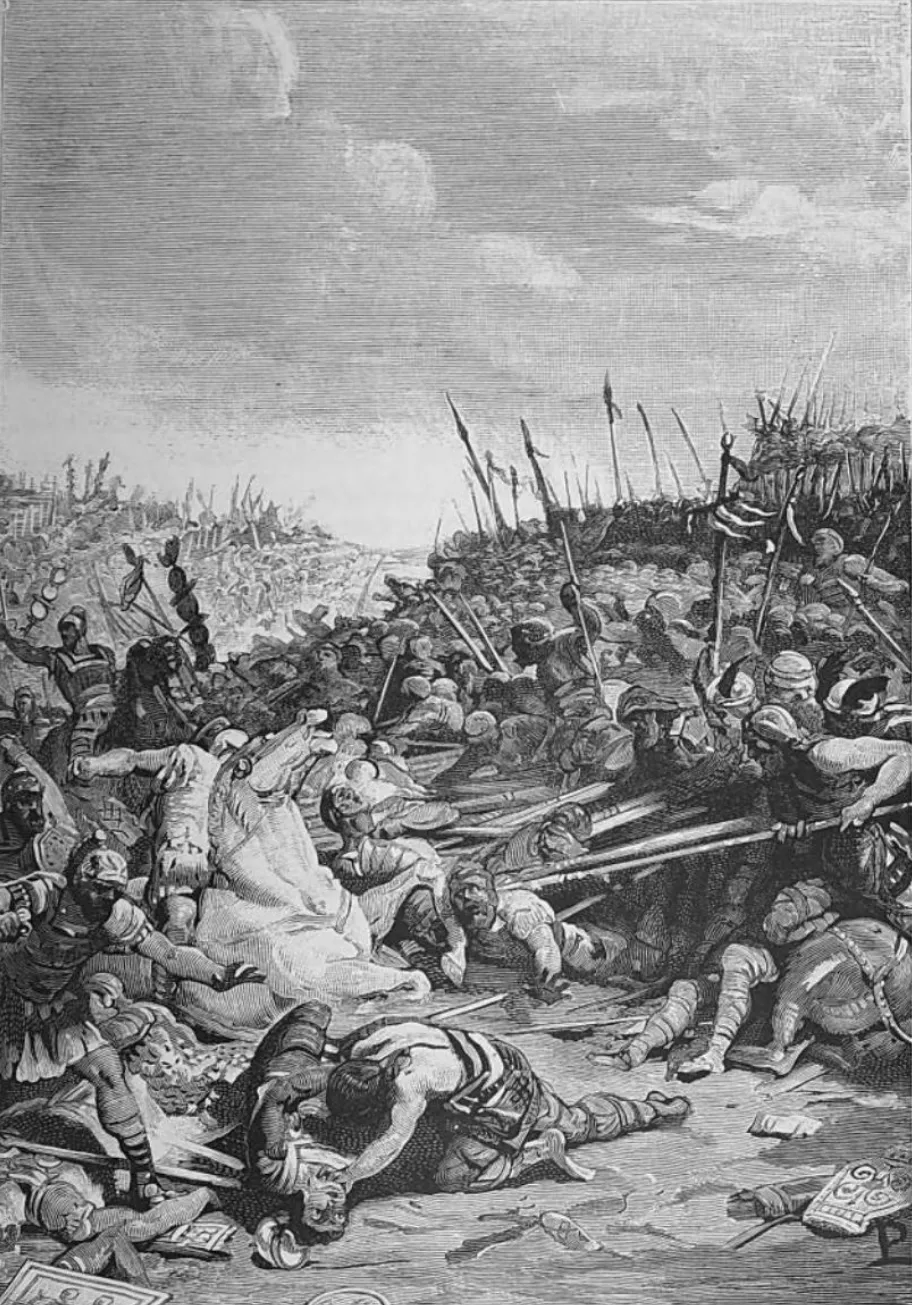
The Germanic peoples lived beyond the Rhine and the Danube, and some had already entered the empire as Roman mercenaries or tenant farmers. In the late 4th century the Huns, nomads from Central Asia, overwhelmed the Ostrogoths north of the Black Sea, and the Visigoths, pushed before them, crossed the Danube into Roman territory in 376. In 378 they crushed a Roman army at Adrianople and killed Emperor Valens.
The Visigoths went on to sack Rome in 410 and found a kingdom in southern Gaul and Spain, while the Vandals crossed to North Africa. The Franks moved into Gaul and the Anglo-Saxons into Britain. Under Attila in the mid-5th century the Huns built a great power based on the Hungarian plain. Amid this turmoil the Western Roman Empire fell in 476, and in 493 the Ostrogoths founded a kingdom in Italy.
The migrations continued until the Lombards entered Italy in 568. Adopting Roman culture and Christianity, the Germanic peoples became the masters of medieval Western Europe. Some regard the Huns as descendants of the Xiongnu, but this is uncertain. As the migrations began, Baekje on the Korean peninsula was at its height under King Geunchogo.