Horatius Cocles at the Bridge
Also called: Horatius, Pons Sublicius, Lars Porsenna, Mucius Scaevola
A legend handed down over the centuries.
A Roman legend told in Book 2 of Livy and by Polybius. When the Etruscan king Porsenna marched on Rome to restore the exiled king, Horatius Cocles held off the enemy alone at the end of the Sublician bridge over the Tiber while his comrades cut it down behind him, then swam back across the river.
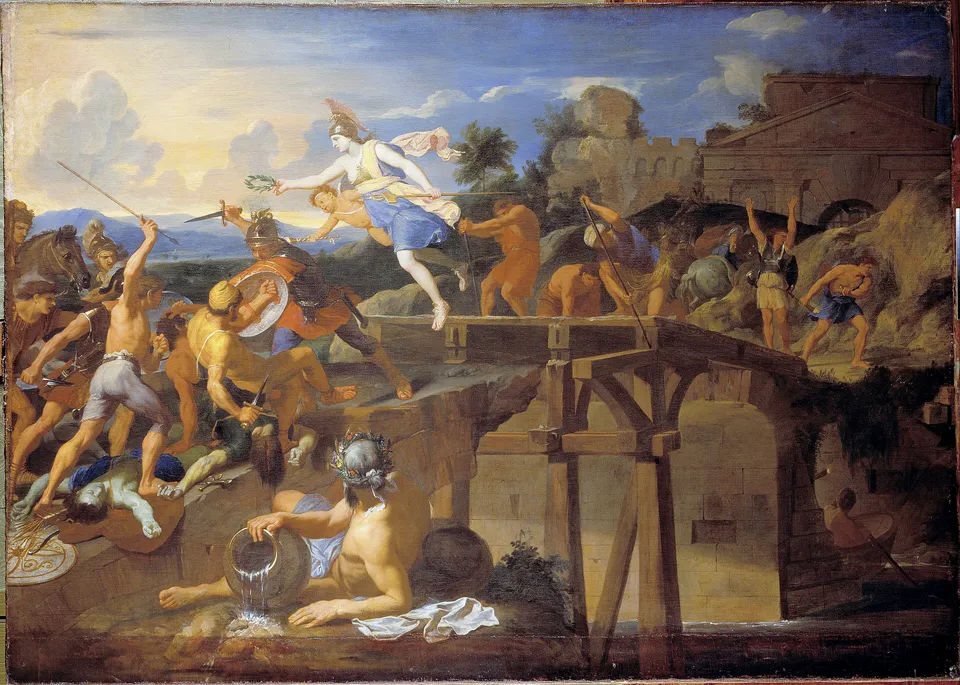
Le Brun, Charles (1619 - 1690) – Artist Details on Google Art Project · Public domain · Source
This Roman legend is told in Livy’s History of Rome (Book 2, chapter 10), and briefly by the Greek historian Polybius (Histories, Book 6). The deposed Tarquinius appealed to Lars Porsenna, king of Etruscan Clusium, whose army seized the Janiculum and pressed on to the Pons Sublicius, the wooden bridge over the Tiber. Horatius, called Cocles (“one-eyed”), on guard at the bridge, shouted to his fleeing comrades to destroy it and held the far end against the enemy, at first with two companions and then alone.
As the bridge fell, Livy says, Horatius prayed to the river god Tiberinus, leapt into the river in full armour and swam back to the Roman bank; Polybius says he drowned. The same war gave rise to the stories of Mucius Scaevola, who thrust his hand into a fire when caught trying to kill Porsenna, and of the maiden Cloelia, who escaped from captivity by swimming the river.
Livy says Porsenna withdrew in admiration of Roman courage, but the historian Tacitus and Pliny the Elder preserve another tradition in which Porsenna actually made Rome submit. Macaulay’s poem “Horatius” (1842) made the story widely known in English.