Myths1200 BC – 147119 events

The Founding Myths of Rome

From Aeneas escaping burning Troy to Dido, Romulus and Remus, the Sabine women and Lucretia — the origins the Romans claimed for themselves, in story order, alongside the sites of Lavinium and the Palatine, the Aeneid and Livy’s History, the Ara Pacis and the Capitoline Wolf
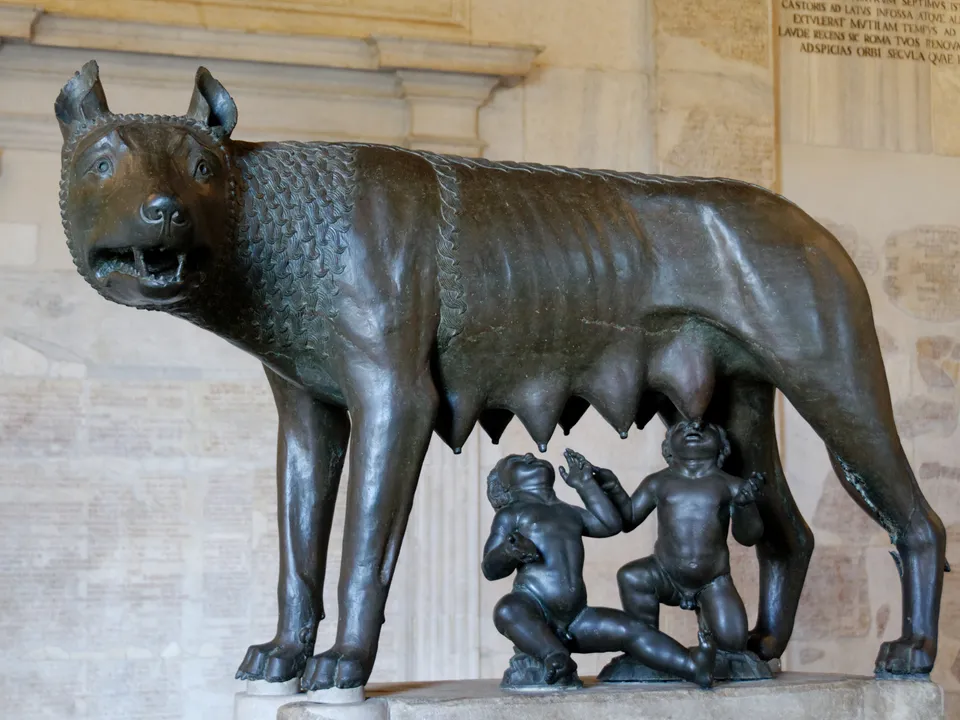
카피톨리니의 암늑대상 — 로물루스와 레무스에게 젖을 먹이는 늑대 (쌍둥이는 15세기에 덧붙였다), 로마 카피톨리니 미술관

Unknown author · Public domain · Source

At a glance

StorySourceKind
Aeneas flees TroyAeneid 2; Iliad 20Legend
Dido and AeneasAeneid 1, 4Myth
Latium and LaviniumAeneid 7–12; Livy 1Legend
Thirteen Altars of Lavinium (6th–4th c. BC)Excavations at Pratica di MareHistory
Kings of Alba LongaLivy 1; DionysiusMyth
Romulus, Remus and the wolfLivy 1; PlutarchLegend
Capitoline Wolf (1471)Gift of Sixtus IV; date disputedHistory
Founding of Rome (753 BC)Livy 1; Ovid, Fasti 4Legend
Palatine huts (8th c. BC)Postholes in the rockHistory
The Sabine womenLivy 1; PlutarchLegend
Numa and EgeriaLivy 1; PlutarchLegend
Beginnings of the Forum (7th c. BC)Regia; Lapis NigerHistory
LucretiaLivy 1; Ovid, Fasti 2Legend
Founding of the Republic (509 BC)Traditional dateHistory
Horatius at the bridgeLivy 2; PolybiusLegend
The Aeneid (29–19 BC)VirgilHistory
History of Rome (from c. 27 BC)LivyHistory
Ara Pacis (9 BC)Lupercal and Aeneas reliefsHistory
Metamorphoses (c. AD 8)OvidHistory

The theme on the map

OpenFreeMap © OpenMapTiles © OpenStreetMap contributors

19 events in this theme

  1. 1184 BCAeneas Flees TroyLegend

    A Greek and Roman myth sung in Book 2 of Virgil’s Aeneid. On the night Troy burned, the Trojan prince Aeneas escaped the flames carrying his old father Anchises on his shoulders and leading his young son Ascanius by the hand, bearing with them the city’s household gods (the Penates).

  2. UndatedDido and AeneasLegend

    A Roman myth sung in Books 1 and 4 of Virgil’s Aeneid. Driven by a storm to Carthage, Aeneas fell in love with Dido, the queen who had founded the city; when the gods ordered him on to Italy, Dido took her own life, calling down eternal enmity between their peoples.

  3. A Roman founding legend told in Books 7–12 of the Aeneid and Book 1 of Livy’s History of Rome. Reaching the mouth of the Tiber, Aeneas was promised Lavinia, daughter of Latinus, king of the Latins; after defeating Turnus, king of the Rutuli, who had been betrothed to her, he founded the town of Lavinium, named after his wife.

  4. At Pratica di Mare (ancient Lavinium) south of Rome, excavations revealed a sanctuary with thirteen large altars in a row, added one after another from the 6th to the 4th century BC, and a 7th-century BC burial mound converted in the 4th century BC into a hero’s shrine. Its identification as a shrine of Aeneas is disputed.

  5. A Roman founding legend told by Livy (Book 1) and Dionysius. Aeneas’ son Ascanius founded Alba Longa below the Alban Mount, and his descendants ruled for three hundred years, until Amulius seized the throne from his brother Numitor and made his niece Rhea Silvia a Vestal Virgin.

  6. A Roman founding legend told in Book 1 of Livy’s History of Rome and Plutarch’s Life of Romulus. The twins Romulus and Remus, cast into the Tiber on Amulius’ orders, were suckled by a she-wolf in the Lupercal cave below the Palatine Hill and raised by the shepherd Faustulus.

  7. In 1471 Pope Sixtus IV gave a group of bronzes from the Lateran, including a bronze she-wolf, to the Roman people and placed them on the Capitoline Hill — the event the Capitoline Museums count as their beginning. When the wolf was made is disputed between an ancient Etruscan and a medieval date.

  8. A Roman founding legend told in Book 1 of Livy and in Ovid’s Fasti. The twins quarrelled over the site of the new city and took the auspices from the flight of birds; when Romulus ploughed the furrow for his walls on the Palatine, Remus mocked it and leapt over, and Romulus killed him and founded Rome, named after himself. The traditional date is 21 April 753 BC.

  9. Around the 9th–8th century BC an Iron Age Latin village of huts stood on the Palatine Hill beside the Tiber. Postholes of the huts survive in the rock on the south-west of the hill, and the Romans kept a “Hut of Romulus” there, rebuilding it as needed.

  10. A Roman founding legend told in Book 1 of Livy and by Plutarch. Lacking wives, the men of Rome invited the neighbouring Sabines to a festival and carried off their daughters; the war that followed ended when the Sabine women, now Roman wives, rushed between the armies — and the two peoples are said to have become one.

  11. A Roman legend told in Book 1 of Livy and Plutarch’s Life of Numa. Numa, the Sabine who succeeded Romulus as Rome’s second king, guided by the nymph Egeria, is said to have created Rome’s religion — its calendar, priesthoods, the Vestal Virgins and the temple of Janus.

  12. The marshy low ground between the Palatine and Capitoline hills, an Iron Age cemetery, was raised and first paved in the late 8th–7th century BC to become a square shared by the hill villages. The Regia of the 7th century and the 6th-century inscription under the “Black Stone” (Lapis Niger) bear witness to this age.

  13. A Roman legend told in Book 1 of Livy and Book 2 of Ovid’s Fasti. When the noblewoman Lucretia, violated by Sextus, son of the last king Tarquinius Superbus, took her own life after making her kinsmen swear revenge, Brutus roused the citizens and drove out the king.

  14. In 509 BC, by tradition, the central Italian city-state of Rome expelled its Etruscan king and set up a republic governed by two annually elected consuls and the Senate.

  15. A Roman legend told in Book 2 of Livy and by Polybius. When the Etruscan king Porsenna marched on Rome to restore the exiled king, Horatius Cocles held off the enemy alone at the end of the Sublician bridge over the Tiber while his comrades cut it down behind him, then swam back across the river.

  16. 29 BC – 19 BCVirgil’s Aeneid

    From about 29 BC, after Augustus had ended the civil wars, the poet Virgil composed the Aeneid, an epic in twelve books on how the Trojan Aeneas came to Italy and laid the roots of Rome. When Virgil died in 19 BC with the poem unfinished, Augustus had it published as it stood.

  17. From about 27 BC the historian Livy of Patavium (Padua) wrote the history of Rome from its founding to his own day in 142 books (Ab Urbe Condita, “From the Founding of the City”). Book 1 tells the founding legends from Aeneas to the end of the monarchy. Thirty-five books survive.

  18. In 13 BC the Senate voted an altar of peace to honour Augustus on his return from Spain and Gaul, and on 30 January 9 BC it was dedicated on the Campus Martius. Its west front shows the twins at the wolf’s cave (the Lupercal) and a sacrifice by a figure usually identified as Aeneas.

  19. Around AD 8 the Roman poet Ovid completed the Metamorphoses, an epic in fifteen books weaving together some 250 myths of transformation from the creation of the world to the deification of Caesar; its last books lead through Aeneas, Romulus and Numa into Roman history. The same year he was banished to Tomis on the Black Sea.

Key people

  • Augustus63 BC – AD 14

    First Roman emperor (r. 27 BC – AD 14); as Octavian, Caesar’s adopted heir, he won at Actium and founded the principate

  • Virgil70 BC – 19 BC

    Roman poet who, after the Eclogues and the Georgics, wrote the Aeneid, the epic of Rome’s founding, in the age of Augustus, and died before finishing it

  • Livy59 BC – AD 17

    Roman historian from Patavium (Padua) who wrote the history of Rome from its founding to his own day in 142 books (Ab Urbe Condita), of which 35 survive

  • Ovid43 BC – AD 17

    Roman poet who wrote the Metamorphoses, some 250 Greek and Roman myths of transformation, and the Fasti on the Roman calendar of festivals; banished by Augustus to Tomis on the Black Sea in AD 8, he died there